As New York businesses invest heavily in automation to combat rising costs, the demand for skilled technicians who can install, maintain, and repair AI-driven hardware has hit a critical shortage. The certifications that get you hired are accessible, affordable, and don't require a college diploma.
Everybody is chasing the screen. Coding bootcamps are packed. Prompt engineering courses are selling out. LinkedIn feeds are flooded with people claiming the only way to survive the age of automation is to learn how to talk to a machine. And while all of that is happening, a different kind of worker is quietly getting very well paid to do something completely different: getting their hands on the machine itself.
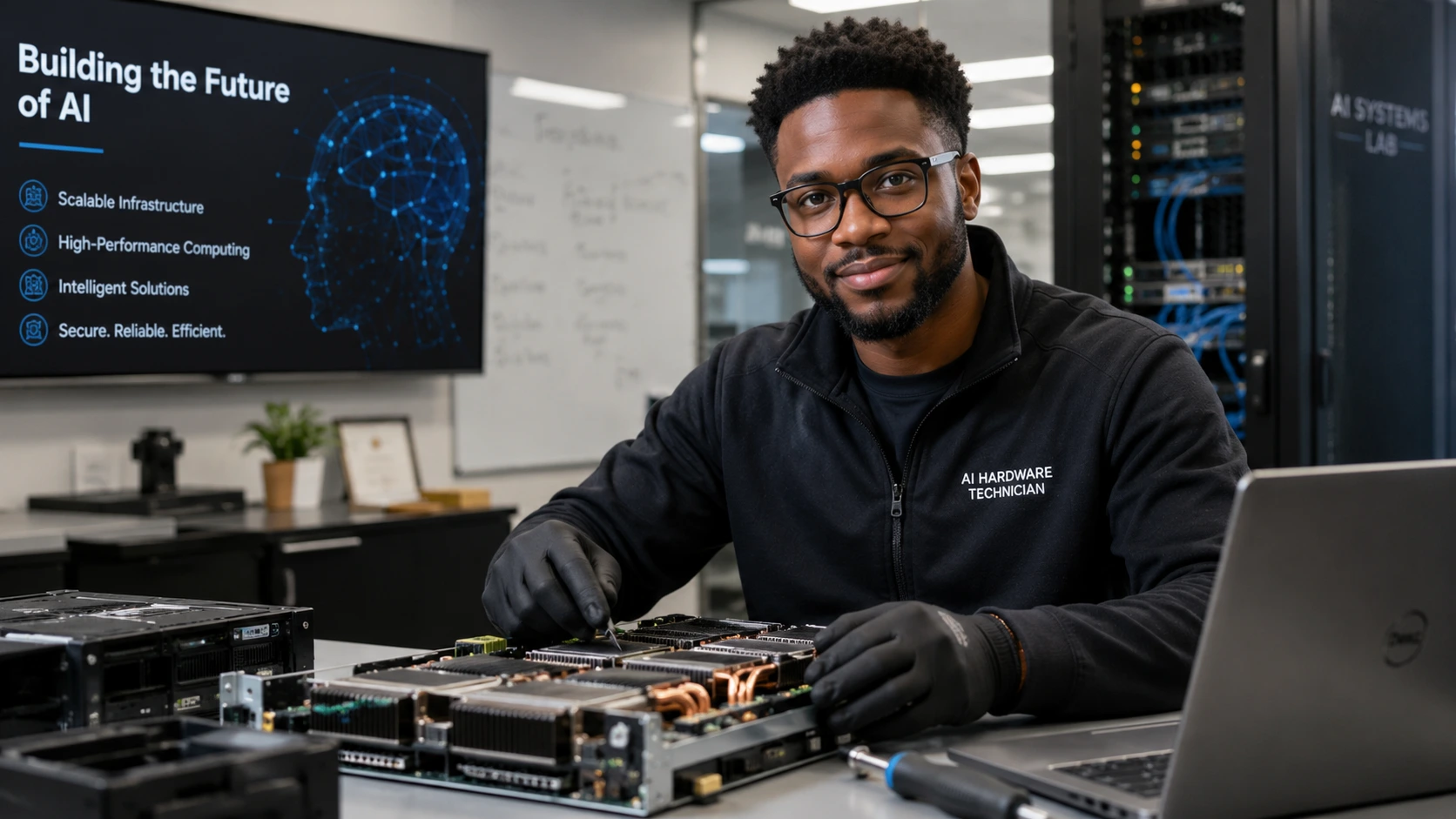
The AI Hardware Technician is one of the most in-demand and least hyped roles in the modern economy. These are the people who install the sensors, calibrate the robotic arms, repair the autonomous sorting systems, and make sure the physical layer of our AI-powered world actually works. And here is what makes this path so compelling for anyone trying to build a real career in New York City right now: no four-year degree required.
Here is something the tech conversation rarely acknowledges: artificial intelligence is completely dependent on physical hardware that breaks, degrades, gets dirty, and needs human hands to fix it. A sophisticated neural network is useless if the robotic arm it controls has a failed actuator. A smart HVAC system in a high-rise is worthless if its sensors are caked in urban grime. The entire promise of automation collapses without someone on the ground who knows how to keep the physical components alive.
This is the gap that nobody in the mainstream tech conversation wants to talk about -- and it is exactly the gap that represents the best no-degree career opportunity in the city right now. We have an abundance of people who can write a script. We have a critical shortage of technicians who can integrate that script into a physical environment, troubleshoot a mechanical failure mid-shift, or commission a new automated system for a Brooklyn warehouse that just switched from manual sorting to robotics.
AI cannot maintain itself. The technician is the most irreplaceable person in the automation economy.
Small businesses across New York -- from local pharmacies using automated dispensing kiosks to neighborhood logistics hubs deploying autonomous shelf-scanning robots -- are investing in hardware at a pace that is outrunning their ability to find qualified workers to support it. That imbalance is not a crisis for you. That imbalance is an opening.
The title sounds futuristic, but the role is rooted in something very familiar: the precision trades. Think of the AI Hardware Technician as the evolution of the master electrician or the specialized mechanic, someone who combines hands-on mechanical knowledge with enough technical literacy to understand how the physical and digital sides of a system interact.
A typical workday does not involve a cubicle. It involves job sites. A technician in this space might spend the morning calibrating the vision sensors on an automated assembly line in Long Island City, the afternoon troubleshooting a conveyor misalignment in a Maspeth distribution center, and the evening documenting a diagnostic report for a client's robotic maintenance contract. The work is varied, physical, and -- critically -- non-exportable. You cannot offshore the person who needs to physically show up and fix the robot.
The core skill set includes understanding how mechanical systems affect digital outputs (a temperature spike in a server rack, for example, can corrupt data just as easily as a software bug), reading and interpreting system diagnostics, performing preventive maintenance on automated equipment, and knowing when to escalate a hardware failure versus patch it on-site. These are skills built through hands-on training, not lecture halls.
The Certifications That Actually Get You Hired
One of the biggest mental blocks people have about entering the tech field is the belief that you need a computer science degree to be taken seriously. In the world of AI hardware, that belief is wrong, and it is costing people real opportunity. What employers in infrastructure and automation are actually looking for is specific, verifiable proof that you can operate and maintain the equipment on day one.
Two certifications consistently separate candidates who get called back from those who do not:
FANUC Certified Robot Operator (FRC-O1)
FANUC is the most widely deployed industrial robotics platform in the world, with over 25 million products installed globally. Their FANUC Certified Robot Operator credential -- managed through NOCTI Business Solutions and offered at certified high schools, community colleges, and training centers -- is a nationally recognized assessment that tests candidates on robot operations, frame setup, program writing, fault recovery, and hands-on simulation using ROBOGUIDE software. The Level 1 certification (FRC-O1) covers core operator skills and is the standard entry point for manufacturing and logistics roles. Training programs typically require around 80 hours of hands-on work, and certification costs at approved training centers typically run between $1,200 and $2,200 -- a fraction of the cost of a semester of college tuition.
PMMI Mechatronics Certification
The PMMI (the Association for Packaging and Processing Technologies) offers a mechatronics certification that is specifically designed for technicians working at the intersection of mechanical systems, electronics, and automated controls -- which is precisely the intersection where AI hardware lives. This credential is recognized by manufacturers, systems integrators, and logistics companies across the country, and it signals to employers that you understand how the physical components of an automated system communicate with its digital brain.
Together, these two certifications represent the kind of Certification Intelligence that Sonic Boom is built around: specific paper that opens specific doors, without the four-year detour. Workers who hold both can command starting salaries that rival corporate office roles, without the student debt that typically comes with them.
The Money Behind the Opportunity
Robotics technician salaries in New York City average around $71,000 to $72,000 per year, with top earners hitting close to $100,000. Entry-level positions -- for workers who are just getting their first robotics certification and landing their first role -- typically start in the $52,000 to $63,000 range. Senior technicians with eight or more years of experience and specialized credentials regularly exceed $89,000, and roles that expand into automation engineering push well past six figures.
The Manufacturing Institute has reported over 600,000 unfilled manufacturing and automation positions across the U.S., with the gap between open roles and qualified candidates expected to grow. New York City, as a dense urban market with a booming logistics sector and a rapidly automating small business landscape, sits at the center of that demand. Amazon Robotics roles in the region, for example, have been posted at salary levels more than 60 percent higher than the average robotics technician baseline -- signaling that the ceiling in this space is still climbing.
Low-wage service roles, the kind that have defined the lower rungs of the urban economy for decades, are increasingly unable to keep up with the real cost of living in this city. The AI Hardware Technician path offers something concrete in response: a way to transition from service work into high-value infrastructure work without going back to school for four years.
This is what the Sonic Boom framework calls the Urban Pivot. It is not just about getting a better-paying job -- although that matters. It is about positioning yourself in a category of work that AI cannot easily replace. Software writes software now. Algorithms generate algorithms. But no algorithm can show up at a facility in Greenpoint, diagnose why a conveyor belt's sensor array is throwing false negatives, and recalibrate the system before the next shift. That requires a person. That requires someone trained in automation maintenance who knows what to look for and how to fix it.
You are not competing with AI. You are the reason AI works at all.
By becoming the technician who maintains the automation, you shift from the category of worker who is vulnerable to technological disruption to the category of worker who makes technological disruption possible. That is a fundamentally different position to occupy -- economically and psychologically.
How to Get Started in New York
The path into AI hardware and robotics maintenance is more accessible than most people assume. FANUC certification programs are available through community colleges and approved training centers, with some programs offering WIOA-eligible tuition assistance for qualifying workers -- meaning you may be able to get trained with little to no out-of-pocket cost. The City University of New York (CUNY) system has programs in mechatronics and industrial technology that align directly with the certifications employers are looking for.
The key is to stop waiting for a perfect on-ramp that looks like a four-year degree and start treating certifications as the real currency they are in this market. FANUC alone has 25 million machines installed worldwide. Learning to operate, program, and maintain those systems is not a niche skill -- it is a foundational skill for the next decade of urban infrastructure work.
If you are currently in a service role and looking for a way out that does not involve racking up $60,000 in student debt, this is worth your attention. The tools are more accessible than they have ever been. The training is specialized and fast. And the demand -- in New York City and everywhere else -- is only going in one direction.
The future of work in this city is not a choice between being a person or being replaced by a machine. It is a question of which side of the machine you are standing on. The AI Hardware Technician stands on the right side: the side that keeps everything running, the side that employers cannot afford to outsource or automate away, and the side that pays well enough to actually live in New York.
The screen-staring economy will keep producing coders. Let it. The workers who understand the physical reality of how automation actually functions -- who can walk into a mechanical room and diagnose a system failure before it shuts down an entire operation -- those workers are building something the algorithm cannot touch: a career that compounds over time, in a city that always needs people who know how to make things work.