The average entry-level analyst on Wall Street pulls in a base salary somewhere between $96,000 and $105,000 a year, according to ZipRecruiter's 2026 compensation data, the reward for a four-year degree, a summer of unpaid networking, and a hiring process built to reject nearly everyone who applies. A diagnostic medical sonographer working inside a New York City hospital system is often pulling comparable pay, and in plenty of cases more, for a credential that takes about two years to earn and comes with none of the recruiting-cycle gauntlet. Nobody markets this fact, because nobody in healthcare staffing has a reason to.
The Two-Year Path Nobody Is Advertising
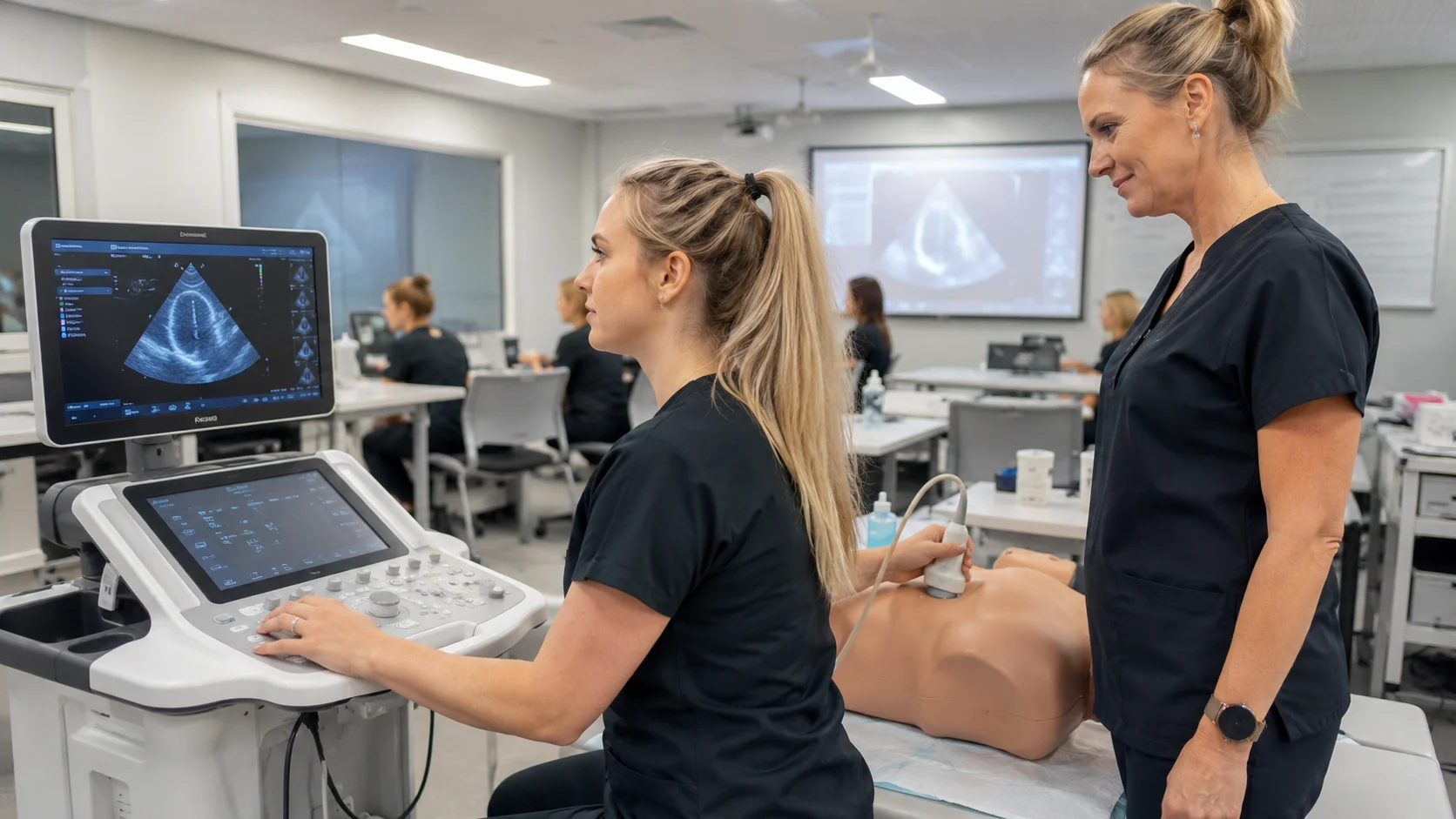
A two-year sonography program is not a shortcut in the derogatory sense. It is a full allied-health credential, typically an associate degree or a postsecondary certificate, built around anatomy, physiology, and roughly a year of supervised clinical scanning inside real hospitals and imaging centers. Programs accredited by the Commission on Accreditation of Allied Health Education Programs, known simply as CAAHEP, run applicants through six-semester curriculums heavy on abdominal, obstetric, and vascular imaging before they ever sit for a national exam.
In New York City specifically, Touro University's sonography program inside its School of Career and Applied Studies runs close to two years of full-time study with no prerequisites required to start, an unusual entry point in a field where most competing programs rank applicants on science and math coursework before they are even admitted. Touro also notes that New York ranks third in the nation for sonography employment, and that the metro area alone employs two to three times as many sonographers as either Los Angeles or Chicago, a concentration of demand most career-changers never hear about until they are already three semesters into a nursing degree they are not sure they want.
What New York Is Actually Paying
Nationally, the Bureau of Labor Statistics puts the median annual wage for sonographers at $89,340 as of May 2024, with the bottom ten percent earning under $65,000 and the top ten percent clearing $123,000. New York consistently sits above that national number. ZipRecruiter's 2026 New York City data puts the average hospital sonographer salary at roughly $99,000 to $120,000 a year, and Glassdoor's New York City figures run higher still once specialty credentials such as cardiac or vascular sonography enter the picture. None of that requires a four-year tuition bill, a graduate degree, or a decade of compounding student loan interest to reach.
The people who train for this job are not chasing a trend. They are chasing a paycheck that shows up whether the economy is booming or bracing for a downturn.
That resilience is not incidental. Diagnostic imaging is considered one of healthcare's more recession-resistant corners, because hospitals do not stop ordering ultrasounds when consumer spending slows. A scan that catches a blood clot or confirms a healthy pregnancy does not wait for a better quarter.
The Aging Population Math
The Bureau of Labor Statistics projects sonographer employment to grow 13 percent between 2024 and 2034, more than four times the average growth rate across all occupations, with roughly 5,800 openings projected every year of that decade. The driver is not mysterious. An aging population needs more cardiac scans, more vascular workups, and more diagnostic imaging generally, and a wave of veteran sonographers is aging out of the workforce at the same time demand is climbing. That is the same dynamic reshaping nursing, except sonography's entry credential is shorter, its clinical hours are more contained, and far fewer people are competing for the open seats in each cohort.
Building the Certification Stack
Getting hired reliably comes down to one credentialing body: the American Registry for Diagnostic Medical Sonography, or ARDMS. Graduates of a CAAHEP-accredited program are typically eligible to sit for the Sonography Principles and Instrumentation exam and a specialty exam, commonly abdomen or obstetrics and gynecology, before or shortly after graduation. An ARDMS certification is what most New York employers actually screen for, not the name of the school on a diploma. Only four states nationally require sonographers to hold a separate state license on top of certification, and New York is not one of them, which means the certification itself is the entire gate.
Once inside the field, sonographers stack additional registries, cardiac, vascular, pediatric, to move into higher-paying specialty and lead roles, or they sign travel contracts through staffing agencies that regularly pay well above a staff hospital's base rate for eight to thirteen week assignments. Cardiac and vascular specialists routinely out-earn general abdominal sonographers by a meaningful margin, and lead or chief sonographers running an outpatient imaging center's daily operations sit near the top of the field's pay scale entirely without a graduate degree in the room. The sonography job outlook rewards exactly the kind of credential-stacking that New York's Care Boom career paths are built around: start narrow, get certified, get hired, then widen the scope of what you are qualified to scan.
Set that against the cost of the more familiar alternative. A traditional Bachelor of Science in Nursing at a private New York institution can run well past six figures once room, board, and four years of tuition are added together, before a single shift is worked. A CAAHEP-accredited sonography program, delivered through a two-year associate track, routinely costs a fraction of that, with clinical rotations built directly into the curriculum rather than bolted on afterward. The debt load at the finish line is not remotely comparable, and the paycheck waiting on the other side is closer than most people assume.
Why a Machine Cannot Take This Job
Every automation-anxious headline about healthcare eventually runs into the same wall: an ultrasound probe has to be held, angled, and read by a human hand and a trained eye, in real time, against a moving target inside a living patient. Software can flag an anomaly after the fact. It cannot replace the person doing the scan. For a state betting hard on no-degree healthcare career paths that AI cannot quietly automate out from under the people who trained for them, that is precisely the kind of job worth pointing readers toward, and precisely the kind of story New York's workforce planners should be shouting from the rooftop of every community college CAAHEP-accredited program in the state.
The degree everyone still defaults to is a four-year bachelor's, financed with debt, aimed at a job market that increasingly cannot promise what it once did. The two-year path into a hospital imaging suite asks for less time, less money, and delivers a credential the labor market is actively short on. That math is not close.