
When people imagine a top-earning healthcare career, they often picture endless years of tough medical school and crushing student loans that seem insurmountable.
In the high-stakes economy of 2026, diagnostic medical sonography has become the ultimate career pivot, offering a sophisticated blend of medical prestige and rapid economic mobility that AI simply cannot replicate. For those coming from low-wage service sectors, the sonography lab is a high-value infrastructure hub where human intuition meets cutting-edge technology.
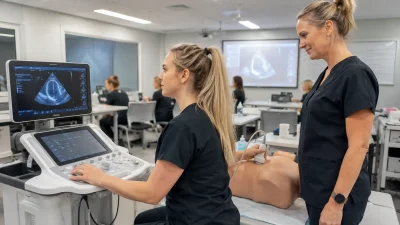
"When I am scanning, a lot of times I feel like I'm in that same flow state like when I would play the piano or paint," explains Samantha Callis, MHA, RDMS, a prominent author and educator in the field. This "one-pointed focus," where the eyes, hands, and brain work together to produce life-saving images, is the hallmark of the Care Boom. If you are ready to stop the grind and start building a future with genuine academic ROI, sonography provides the blueprint for success in the modern urban landscape.
The Care Boom: Why Sonography is Recession-Proof
The Care Boom is fueled by an aging population and a dense urban landscape that demands constant, non-invasive diagnostics. Unlike roles that are vulnerable to the Automation Boom, sonography requires physical presence and real-time clinical judgment. You aren't just pushing buttons; you are acting as the Doctor's eyes, evaluating complex internal structures so that life-saving decisions can be made in the ER or ICU.
Carlos Reveles, an RDMS specializing in high-risk OB/GYN, describes the weight of this responsibility: "I evaluate the fetus so the Doctor can give the best diagnosis." Industry veteran Yonella Demars, PhD, RDMS, echoes this sentiment, noting that sonographers are "commissioned to be the best each time we pick up the transducer... it's about the patient!" This specialized med-tech role sits at the center of urban healthcare support, used in everything from cardiology to obstetrics. This diversity creates future-proof skills because healthcare diagnostics are a permanent necessity; your career remains resilient even when other sectors of the economy slow down.
The Two-Year Six-Figure Path
The most empowering part of this career is its efficiency. Through Certification Intelligence, we know that an Associate’s degree from a program accredited by the Commission on Accreditation of Allied Health Education Programs (CAAHEP) is the industry "gold standard." While others spend four to six years on general degrees, a focused student can be clinical-ready in approximately twenty-four months.
This is the Career Lab approach in action: finding the shortest path to a high-value role. High-performing sonographers like Reveles, who attended PIMA Medical Institute, show that excellence is rewarded rapidly; he was recognized as a regional "Sonographer of the Year" just a few years into his career. By focusing on specialized certifications rather than general education, you maximize your earning potential while minimizing time out of the workforce.
In cities like New York or Chicago, the "cost of living" crisis is a daily reality, but sonographers in these hubs are among the highest-paid professionals without a traditional four-year degree. Because these cities house major research hospitals and specialized clinics, the demand for Specialized Med-Tech is at an all-time high. You move from the low-wage trap to a position where you have the financial floor to live in the city you serve.
Samantha Callis points out that "now is the best time to negotiate for the salary you want," especially if you leverage market research and "Shift-Diff" incentives, extra pay for nights, weekends, or specialized rotations. This is Urban Economic Mobility in action. You aren't just getting by, you are building a stable career that supports a modern urban lifestyle and provides the resources to invest in your own future.
While technical mastery is critical, your "Street-Smart" intuition is what truly secures the role against AI.
A machine cannot guide a nervous patient through a difficult diagnosis or adjust its physical technique based on a patient's discomfort. "Nothing is better than when the patient tells you thank you for making the ultrasound great," Reveles shares. Practitioners must possess "grit" and "confidence," learning to navigate complex clinical environments where split-second decisions matter.
In the Career Lab, we focus on outcome-driven narratives. Your ability to communicate clearly with both patients and physicians is a high-value asset. The soft skills developed in retail or hospitality are incredibly relevant here; you are the bridge between the patient’s fear and the doctor’s medical analysis. Yonella Demars reminds us that the technical work is always secondary to the human element: "It is about the patient!" This blend of technical mastery and emotional intelligence makes you an indispensable part of the modern medical team.
Navigating the Sonography Landscape
To succeed in the Care Boom, you must understand the landscape of the profession. It is a field that rewards those who are solution-focused and direct. Whether you are working in a bustling urban hospital or a specialized private clinic, the expectations remain the same: precision, professionalism, and a commitment to patient care.
The profession is also becoming more inclusive, with a growing number of male sonographers entering traditionally female-dominated specialties like OB/GYN. While challenges exist, such as the need for chaperones or overcoming patient biases, Reveles encourages men to "go for it" and "study as much as possible." The high demand for skilled technicians means that job opportunities are abundant for anyone with the right certification. The industry is increasingly recognizing that talent and dedication are the primary metrics for success, regardless of gender.
The Blueprint for Your Transition
Ready to transition to the Care Boom? Here is your "Strategic How-To" guide for navigating the career:
Research Accredited Programs: Find CAAHEP-accredited schools with strong clinical rotations, as these provide the best hands-on training.
Identify Your Specialty: Whether it’s vascular, cardiac (fetal echo), or high-risk OB, picking a niche increases your Certification Intelligence and market value.
Master Communication: You must be able to communicate your needs and technical findings clearly to your medical team to ensure patient safety.
Leverage Mentorship: Finding a mentor is crucial, as Callis and Demars both emphasize that sonography is a "commitment to continual education" and technical refinement.
Focus on the ARDMS: This is the primary credential that guarantees your professional standing and allows you to bypass traditional bureaucratic hurdles in hiring.
Prepare for Clinical Rotations: Treat your clinical time as a months-long job interview where you build the "paper" and the reputation needed to secure a high-pay role.
A Future of Stability and Impact
The Sonic Boom is about the urban pivot to a life of meaning and security. Sonography allows you to be at the forefront of medical technology while maintaining the human connection that makes healthcare rewarding. You become a solution-focused professional in an era of automation, proving that human expertise is the ultimate asset.
As you look at the city skyline, don't just see a crisis, see a network of hospitals and clinics waiting for specialized experts like you. The path to economic mobility begins with a transformation and a commitment to excellence. As Carlos Reveles puts it: "I love what I do and wouldn't change my career for anything."
It’s time to take control of your career, master the Care Boom, and build a future that is as stable as it is successful.