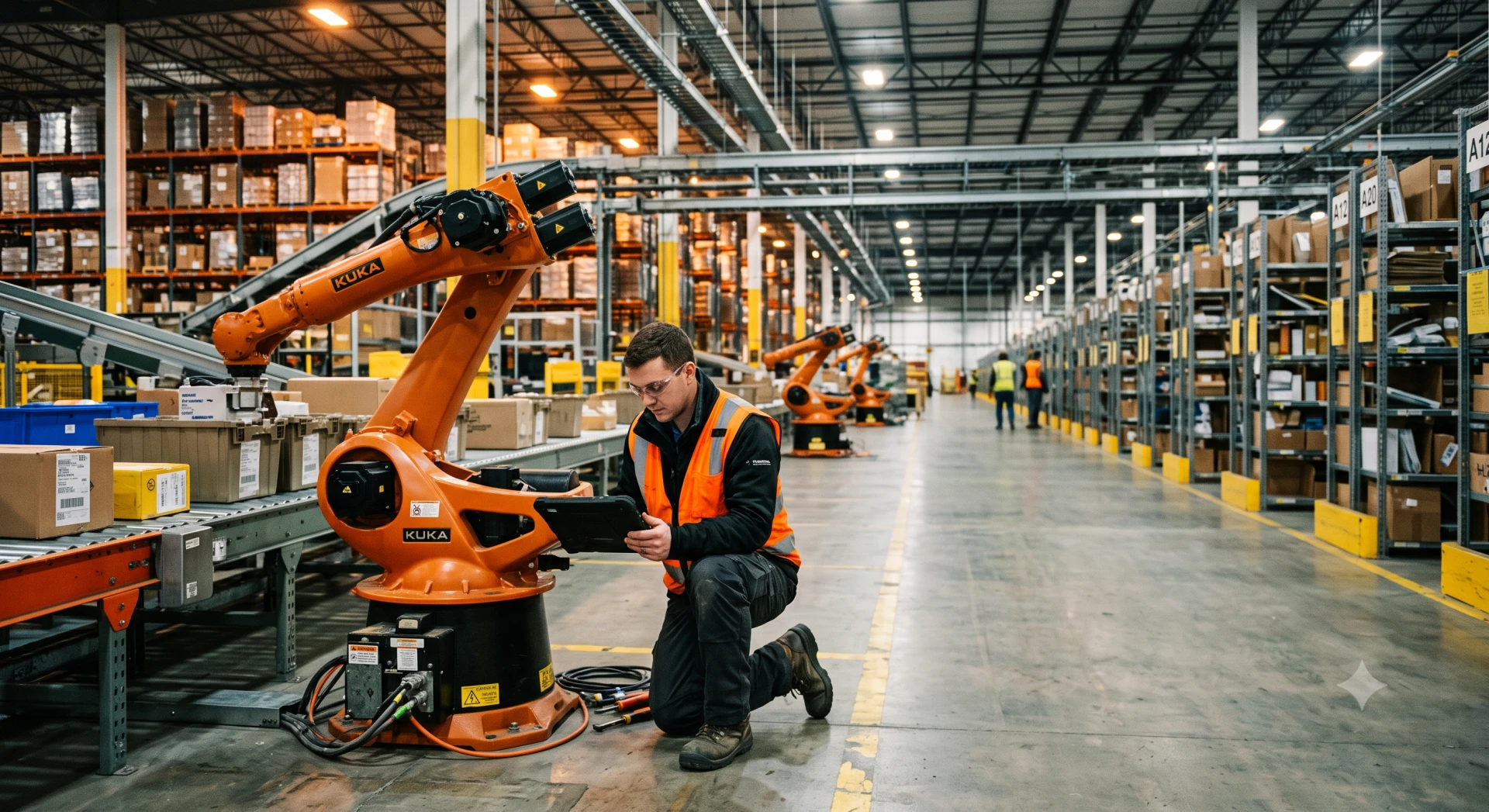
The picker who walked out of an Amazon fulfillment center in Staten Island in 2019 made about $15 an hour. The technician who walked in a decade later, into the same building, to keep the robotic arm that replaced him running, is now making close to $42. Same square footage. Same fluorescent lights. Different floor of the wage ladder, and it is not a small step up.
This is what actually happened when Amazon automated warehouse work in New York. The picker jobs did not vanish so much as they were rezoned. Some of them moved to the driver seat of a Rivian van. Others got absorbed into quality control and inbound receiving. But the money, the real money, went to a role that most people outside the industry still cannot name: the robotics maintenance technician. Amazon calls them Mechatronics and Robotics Technicians, or MRTs. The pay data tells a story that career counselors at most New York high schools have not caught up to yet.
The Wage Gap Automation Actually Created
According to Glassdoor's most recent salary data, an Amazon Robotics Technician earns an average of $84,986 a year, with the 75th percentile at $108,199 and the 90th percentile reaching $133,622. The company's own Amazon RME program, the Reliability and Maintenance Engineering apprenticeship, reports even stronger numbers for its graduates: Glassdoor's data on Mechatronics and Robotic Apprenticeship completers shows an average of $87,536 with the top decile at $142,689. A general warehouse associate at the same facility, by contrast, starts around $19 an hour. That is not a promotion. That is a career change dressed up as one.
The gap did not open by accident. When Amazon acquired Kiva Systems in 2012 and started rolling its orange robots into fulfillment centers, the internal calculation was straightforward. A picker walks eleven miles a shift and produces a fixed output. A robot moves inventory in a grid and produces multiples of that output. But a robot also breaks. A robotic arm has actuators that wear, pneumatic systems that leak, sensors that drift, and PLC networks that need re-flashed firmware. Every fulfillment center now runs on hundreds of these units, and every one of them needs someone qualified to diagnose the fault when it stops moving. That someone is the MRT. And the labor pipeline for MRTs is empty in a way that is starting to hurt.
The Federal Data Nobody Is Reading
The Bureau of Labor Statistics projects that employment of industrial machinery mechanics, machinery maintenance workers, and millwrights will grow 13 percent between 2024 and 2034. That is more than four times the average across all occupations. The BLS estimates 54,200 openings in this group each year over the decade, most of them driven by the two forces reshaping American logistics: the buildout of automated fulfillment and the retirement of the technicians who built the previous generation of factory equipment.
The BLS is explicit about the driver in its own outlook: the continued adoption of automated manufacturing machinery is expected to create jobs for these workers. In other words, the government's own labor economists are telling anyone reading closely that automation is not the end of the maintenance floor. It is the beginning of a new one, staffed by people who understand both the mechanical guts of a machine and the code running through its controller.
Automation did not remove human labor from the warehouse. It moved the wage floor from $19 an hour to $42 and left the top of the pipeline wide open. The job is there. Almost no one has trained for it yet.
What the Pipeline Actually Looks Like in New York
There are three real doors into the field for someone without a four-year degree, and they are all open right now in New York State.
The first is Amazon's own mechatronics apprenticeship, the Reliability and Maintenance Engineering MRA program. It is registered with the U.S. Department of Labor. Twelve weeks of paid classroom training at one of five higher-education partners, room and board included, followed by 2,000 hours of on-the-job learning under a technical maintenance specialist. No prior technical experience required. Applicants who see the program through complete four industry-recognized credentials, earn college credit toward a degree, and step into an MRT role that pays roughly 40 percent more than the warehouse floor they came from. Amazon has been running the program since 2020, and the cohort sizes are growing rather than contracting. Buffalo-area postings for contract robotics technicians are live on the major boards through the summer.
The second door is the SUNY community college system, which has quietly built one of the more coherent public pipelines into automation careers anywhere in the country. SUNY Adirondack, SUNY Broome, SUNY Corning, and Fulton-Montgomery Community College all offer two-year mechatronics or robotics and systems technology associate degrees. SUNY Adirondack's program is transferable to Alfred State and SUNY Canton for a bachelor's if a student wants to keep going. SUNY also offers accelerated microcredentials in robotics and automation and in mechatronics that can be completed in eight weeks of full-time study, with day-one preparation for entry roles in PLC programming, control systems, and instrumentation.
The third door is direct certification. FANUC certification, specifically the Certified Robot Operator 1 and the Certified Robot Technician credentials, is the industry standard in a market where FANUC robots are the dominant hardware on North American factory floors. The CERT curriculum runs through partner community colleges and technical training providers, and the assessments are recognized nationally. Pair a FANUC credential with a Siemens Mechatronic Systems Certification or a SACA Industry 4.0 credential and a candidate has the résumé that pulls interview requests at every distribution hub within a Brooklyn commute.
The Roles That Are Not Amazon
Amazon gets the coverage because Amazon has the marketing budget, but the demand is broader than one company. The MTA's rolling stock shops maintain train components that increasingly run on automated diagnostic systems and require technicians who can read a PLC ladder logic diagram. JFK-adjacent freight forwarders and the pharmaceutical distribution centers that ring Newark run on packaging lines that are effectively small factories. Upstate manufacturers, the ones that survived the last two decades of consolidation, have retooled around robotic welding cells and automated assembly. Every one of them is hiring technicians. Every one of them is paying above the county median wage to do it.
The BLS median for the closest matched federal occupational code, electro-mechanical and mechatronics technologists and technicians, was $70,760 in May 2024. That is the floor, not the ceiling, and it applies to a role that requires an associate's degree or a postsecondary certificate rather than a four-year diploma. In New York, once locality adjustments and Amazon-scale employers enter the picture, the realistic entry range for a credentialed graduate stepping into a fulfillment or manufacturing MRT role is closer to $58,000 to $72,000 in the first year. Two or three years of experience and a stacked certification file pushes that into the mid-$80,000s. Senior MRTs and control systems technicians clear six figures without leaving the maintenance floor.
Why This Is the Cleanest Bet on the Board
Most no-degree tech jobs in the current market carry an implicit fragility. Coding bootcamp graduates are competing with AI coding assistants that did not exist eighteen months ago. Data entry and administrative roles that once absorbed workers displaced from retail are being absorbed themselves by the same automation stack that is creating the MRT boom. The rare category that gets stronger as the automation curve steepens is the category of workers who fix the machines doing the automating. That category is not shrinking. It cannot shrink, structurally, without the whole system breaking down.
Robotics maintenance is one of the few paths into six-figure trade jobs where the demand is not a policy artifact or a temporary hiring surge. It is a structural feature of how the American economy is being rebuilt around automated fulfillment and reshored manufacturing. The federal projections extend to 2034. The New York State training infrastructure is in place. Amazon is subsidizing the classroom cost for anyone willing to take the seat. The bottleneck is not funding, not curriculum, and not employer demand. It is candidates.
The Bottom Line
The picker did not lose to the robot. The picker who trained for the robot's maintenance schedule won. The pay ladder is documented, the certification stack is public, the community college pipeline is state-subsidized, and the job postings are open right now across the metropolitan region and upstate. Every fulfillment center that opens in New York over the next five years will need MRTs. The salary data suggests the ones who move first will be reading it from the top of the ladder while the rest of the labor market is still asking whether AI took the warehouse job.