In May 2026, Sports Video Group published findings from an education-technology company called Wiingy that had done something useful: it tested the AI disruption predictions from 2017 against three years of real-world data. The headline was not comfortable. Broadcasting, it found, was among the hardest-hit industries in the U.S. economy, with technical roles posting the steepest real-wage declines and some of the most significant workforce contractions of any occupation studied.
If you stopped reading there, you might conclude that broadcast technician career paths are headed toward obsolescence. That would be the wrong conclusion, and the same report explains why.
The disruption is real, but it is not uniform. What is dying in broadcasting is the routine. What is surviving, and in some cases growing in value, is the skill that cannot be scripted: the live event control room, where every second of air is someone's real-time judgment call, and where nothing has a retry button.
Let's be direct about what has changed. AI-based tools have moved into production workflows for transcription, captioning, automated highlight cutting, voice synthesis, and master control functions in broadcast environments that run predictable, scheduled programming. In those contexts, dedicated technical staff have often become less necessary. The Wiingy analysis found that broadcasting shows workforce contraction without the wage premium survivors typically see in other fields, which suggests the sector has absorbed automation faster than it has adapted.
The jobs most vulnerable in this shift are the ones built around repetitive, predictable execution: ingesting feeds, managing file transfers, running playback on scheduled content, generating clips from games that have already concluded. These are tasks with known inputs and known outputs, and that description is the definition of what automation handles well.
Live events are the opposite of that description.
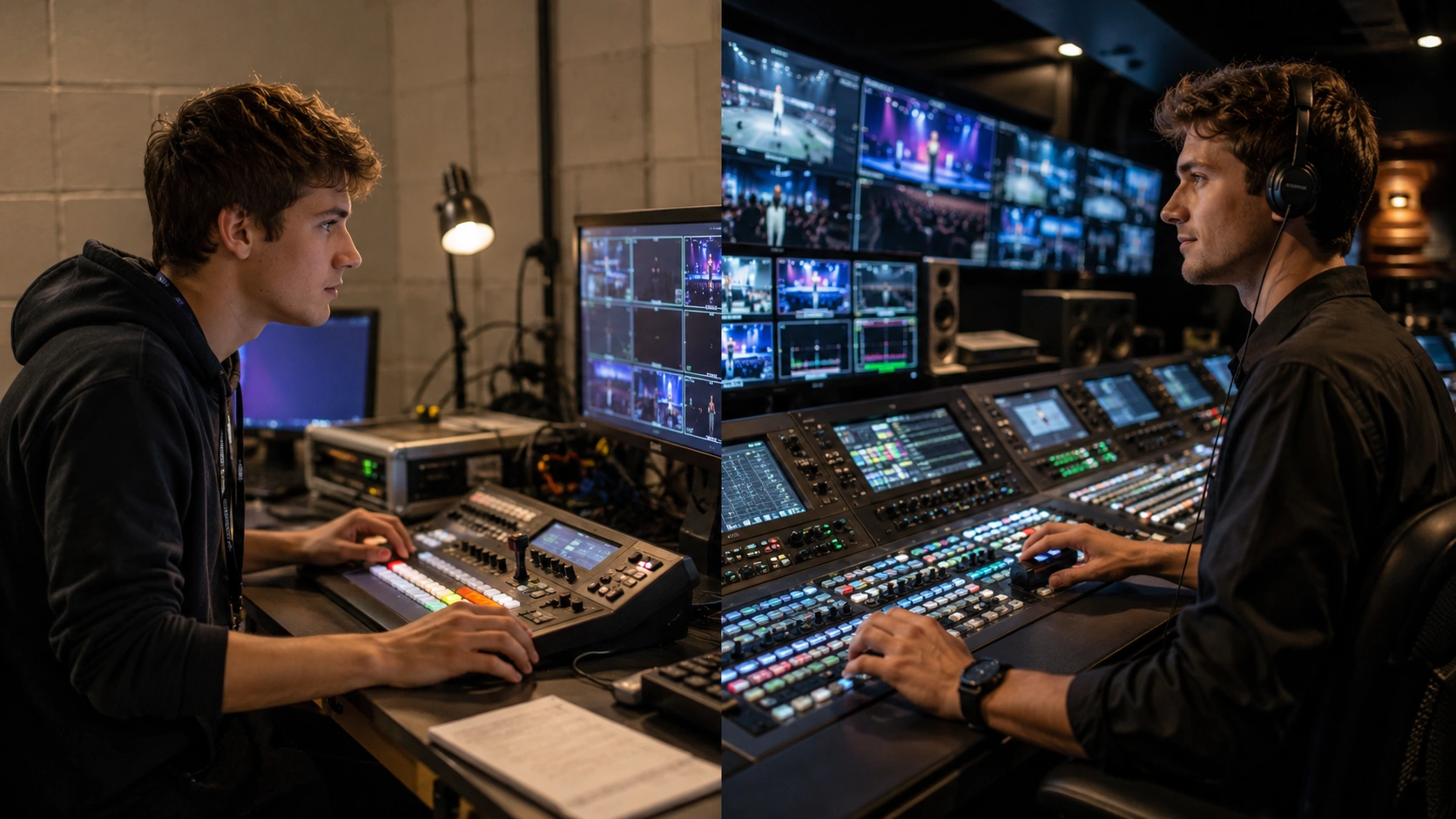
When the Knicks and Spurs played in what the Sports Video Group called the most-watched NBA Finals since the Jordan Bulls era, there were technical directors in control rooms making decisions in real time that no AI system was making for them. Which camera to cut to when a fight breaks out. How to handle a graphics feed dropout with thirty seconds left in the fourth quarter. What to do when a microphone fails during a timeout interview that is already on air.
Live event production is a category of work that compounds in unpredictability. The Wiingy report introduced a concept called the Director Shift to describe what is actually happening in the broader broadcast industry: search demand for video editing and production skills more than doubled after the launch of AI tools, even as traditional job titles contracted. The skill is not dying. The role is evolving. The person who survives and earns more is the one who has moved from executing routine tasks to running the systems that handle routine tasks while personally managing everything the system cannot.
In a live event control room, that evolution is not theoretical. It is already the job description. The technical director at a concert at Madison Square Garden is not competing with an algorithm for that role. The algorithm does not know what to do when the headliner's in-ear monitor fails four songs into the set and the monitor engineer needs the control room to reroute signal in under ninety seconds. A person who knows that environment makes that call. There is no substitute.
What This Career Actually Pays in New York
The salary data for AV control room jobs in New York tells a specific story. The average broadcast technician in New York City earns $72,721 per year as of 2026. Audio visual technician salary figures in New York average $67,004 annually, with the 75th percentile reaching $83,632. Early-career AV technicians with one to four years of experience in New York average $75,000 in total compensation. Hourly rates for AV work in New York as of June 2026 average $38.40, with the range running from $28 to $72 depending on the venue, the role, and the operator's credential level.
The ceiling moves significantly with certification. Professionals holding the AVIXA Certified Technology Specialist credential, the globally recognized standard for AV professionals, earn 10 to 18 percent more than non-certified peers in equivalent roles. Senior certified integrators and AV engineers with the CTS designation can reach $80,000 to $110,000 or above. The average salary across CTS-certified professionals broadly exceeds $112,000, according to certification prep resources tracking real-world compensation data.
None of these roles require a four-year degree as a baseline. Entry-level positions in many live event and venue environments require a high school diploma. Advancement follows demonstrated skill and credentials, not tuition history.
The AVIXA CTS certification is the credential that the professional AV industry actually uses to sort candidates. The Certified Technology Specialist program is the leading credential in pro AV globally, with more than 13,000 holders worldwide and ANAB accreditation to the ISO 17024 standard, the same framework that governs professional certifications across engineering, medicine, and public safety. Clients and government entities at the project level increasingly mandate that at least one CTS-certified professional be on-site, which means the credential does not just signal competence. It is a requirement for the work.
The Society of Broadcast Engineers offers a parallel certification track specifically for broadcast environments. Both credentials are voluntary in the sense that no law requires them, but both function in practice as the difference between candidates who get interviews and candidates who do not.
The investment required to sit for the CTS exam is a fraction of what a community college course costs. The return, measured in starting salary and advancement speed, is not a fraction of anything. It is a multiplier.
New York is one of the densest live event markets in the world. UBS Arena, Madison Square Garden, Barclays Center, Citi Field, Yankee Stadium, Radio City Music Hall, the Beacon Theatre, and dozens of broadcast facilities across the boroughs and the broader state all run AV operations. They all need people in the control room.
UBS Arena has been actively hiring and training event-day operators for technical control room functions. Encore Global, the exclusive on-site event technology provider to more than 1,500 venues worldwide, maintains a significant New York presence and recruits AV technicians for permanent and event-specific roles. MLB's Replay Operations Center, which supports all thirty major league clubs, runs part-time engineer positions at $25 per hour as a documented entry point into the broadcast-adjacent market.
These are not hypothetical job categories. They are posted openings, current as of this writing, in a market where New York tech jobs in AV and live production outnumber qualified candidates in several specializations.
The AI-Resistant Career Bet
The word "AI-resistant" gets used loosely. It is worth being precise about what it means here. AV control room work in live event environments is not AI-resistant because it is old technology or because the industry has failed to automate it. It is AI-resistant because the defining characteristic of the work is irreducible real-time human judgment in an environment where conditions change faster than any model can be trained on.
Automation handles what it can predict. Live events are defined by what cannot be predicted. That gap is where the technical director lives, and it is a gap that is widening, not closing, as production complexity increases. More cameras, more feeds, more simultaneous streams, more audience engagement technology, more integration between in-venue and broadcast output: all of it increases the cognitive and technical load on the people in the room, which means the skilled human operator becomes more valuable, not less, as the tools around them become more capable.
The Wiingy report's Director Shift concept captures this precisely. The broadcast industry is not shedding expertise. It is shedding the parts of the job that did not require expertise, and concentrating value in the people who have it.
How to Start
The entry path into live event AV in New York does not begin with a four-year program. It begins with proximity to the equipment. Community college AV programs and technical training providers offer certificate programs in audiovisual technology and digital media production that take months, not years. Volunteering or interning at a local venue, a house of worship with a broadcast setup, a community theater, or a campus production environment builds the hands-on hours that the industry actually evaluates at the hiring level.
From there, the path is a credential and a portfolio of live hours. The CTS exam is the credential. The live hours come from any production environment where you can get into the room and work a board. Large venues hire event-day operators at entry wages and train them internally. The operators who move up are the ones who show they can stay calm when something breaks live.
New York is not short on live events. It is short on people