New York State employed 6,350 electrical power-line installers and repairers in 2024, and the state Department of Labor expects that number to reach 7,000 by 2034. What matters sits in the second column of the same projection: of the 565 openings the state expects every year in this trade, only 65 come from growth, and 500 come from replacing people who leave. Roughly nine of every ten chances to enter this work exist because someone ahead of you is retiring.
The pay on the other side of that door is the highest on this site's list of jobs that never ask for a bachelor's degree. Federal wage data for May 2025 puts the New York median for the occupation at $121,280 a year, or $58.31 an hour, against a national median of $95,320. The tenth percentile in New York, meaning the bottom of the wage distribution rather than a starting apprentice rate, sits at $58,740.
Here is the direct version. Line work in New York pays six figures at the middle of the distribution, requires no college degree, and is entered through three doors: a community college certificate, a utility-partnered training program, or an outside lineman apprenticeship. Two of those doors have published costs and live contact numbers right now. The third, the apprenticeship, is the cheapest and the hardest to time, because the statewide window is not currently posted.
Why the work is there
The demand story is not a forecast, it is a construction schedule. National Grid is investing more than $4 billion in its upstate New York electric transmission system over the next seven years, and the company has said that work will require about 1,700 workers. Con Edison proposed $21 billion in investments over three years for the system serving 3.7 million customers in New York City and Westchester. The New York Power Authority finished Smart Path Connect with 100 miles of transmission upgraded, four new substations and roughly $438 million in projected annual savings, and its next tranche runs through National Grid's Upstate Upgrade, Champlain Hudson Power Express and Propel NY Energy.
Underneath the capital plans is a load problem. In its Power Trends 2025 report, the New York Independent System Operator wrote that in 2022 six large load projects in the interconnection queue accounted for 1,045 megawatts, and that as of April 2025 there were twenty large load projects in the queue which would collectively add nearly 4,400 megawatts of load to the grid. Rich Dewey, the system operator's president and chief executive, put the operating reality plainly: "The grid is undergoing rapid and instrumental change. We continue to observe declining reliability margins while forecasting a dramatic increase in load."
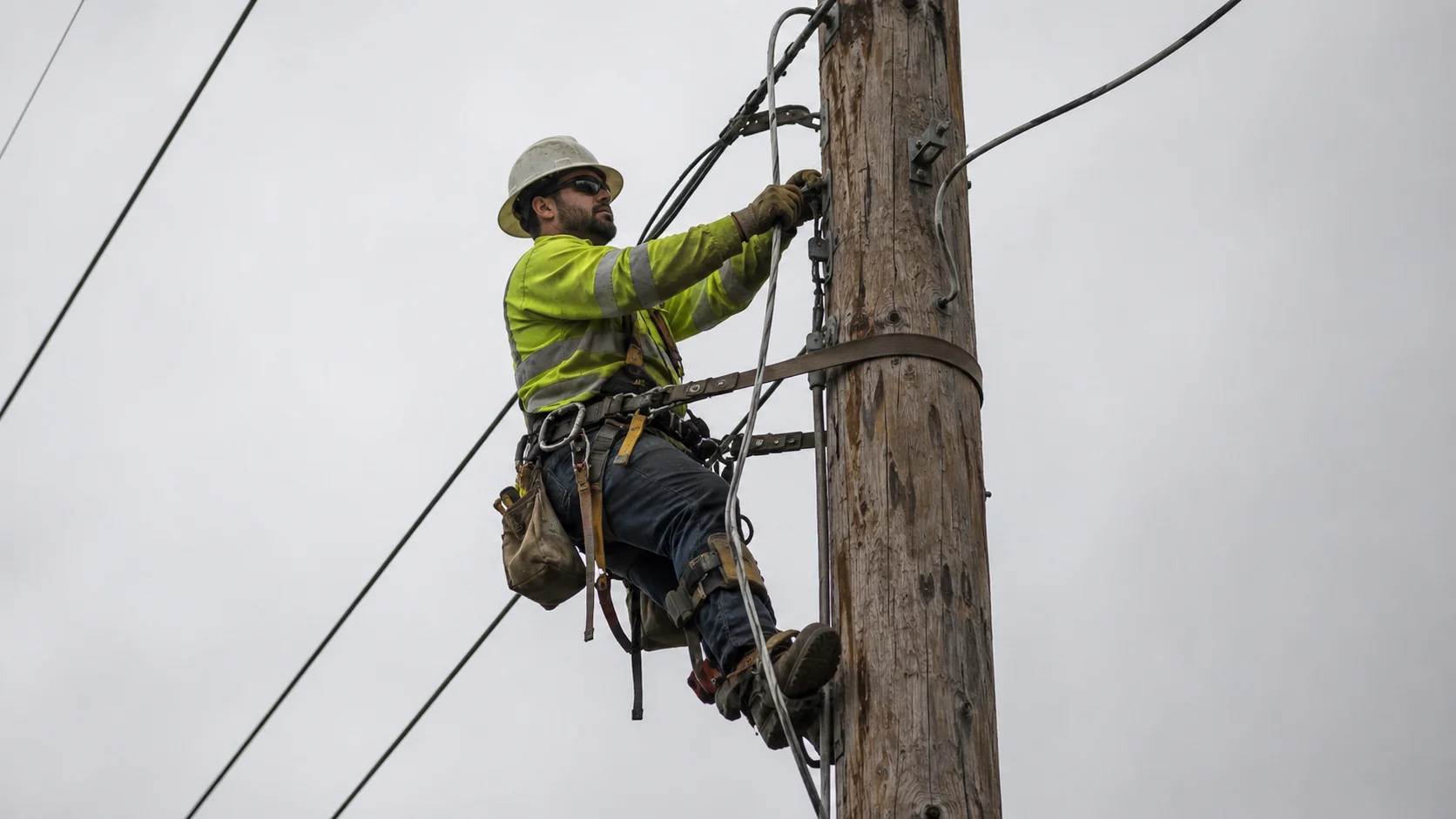
Somebody has to build and maintain all of it, in weather, at height, on energized equipment. Matt Barnett, National Grid's chief of operations for electric in New York, described the squeeze from the employer's side of the table.
"The demand for electric line workers has increased over the past five years, both locally and across the country, and this trend will continue to grow as our current line workers retire. At the same time, the number of projects that require this kind of expertise is also rapidly increasing."
Read that against the state's own projection and the two halves match. The retirements are the opening, and the projects are the reason nobody is waiting for you to finish a four-year degree first.
Door one: Hudson Valley Community College, Troy
HVCC runs an Overhead Electric Line Worker Certificate that takes three semesters, with a lineworker lab in Williams Hall and training that also uses National Grid facilities. Full-time tuition for a New York State resident is $2,654.50 per semester for 2026 to 2027, after the Rensselaer County Legislature approved a $126.50 increase that ended three consecutive flat years.
The money gets more interesting once the scholarship enters. National Grid's Electric Worker Scholarship pays $7,000 per student toward tuition, fees and books, and adds tool kits, job-site tours and mentoring from National Grid employees. Fifteen students received it in 2025, twelve of them new awards and three renewals, and it is open to students in either the line worker certificate or the electrical construction and maintenance degree. Michael Brophy, the college president, called the awards a signal of "the positive impact that each student will have on the future of the electrical industry," which is the kind of sentence a college president says, though the underlying arithmetic is harder to dismiss: $7,000 against roughly $8,000 of resident tuition across three semesters.
The department's own description of a good candidate is more useful than any brochure. "If you have a strong aptitude for problem solving, like working outside, are not afraid of heights and are physically fit, this may be the career for you." The published technical standards get more specific, requiring students to lift a minimum of 50 pounds, climb ladders and scaffolding, stand for long periods, distinguish between various colors of wire and indicator lights, and "clearly communicate the status of potentially energized equipment." Christopher McNally chairs the Applied Technologies department.
Door two: SUNY Broome and NYSEG, Binghamton
The SUNY Broome Lineworker Training Program is the one built with a utility inside it. Students move through about six months of instruction split around a sixteen-week paid internship at NYSEG sites assigned across New York State, with hands-on training at the utility's Johnson City facility and IBEW Local 10 as a partner. The published price is $9,900, which the program says includes all training and required climbing equipment, plus a $100 deposit tied to the physical assessment.
Timing is the catch, and the 2026 cycle shows the shape of it. Information sessions ran January 8 to February 4, physical assessments were held February 16 to 20, applications closed March 5, classroom work ran April 13 to May 21, the internship runs June 1 to September 18, and the final training block runs September 28 to October 16. That cohort is inside its internship right now, and the program page states that information sessions for the 2026 program have ended.
What is live today is the interest form for 2027, which sits on the college's 2027 Lineworker Training Program page and asks only that you check a box to receive updates on future offerings. No 2027 dates have been published yet, so the honest guidance is to submit that form now and expect the January information-session pattern to repeat rather than to plan around dates nobody has announced. The workforce office answers at 607-778-5012.
On outcomes, the program's first class graduated 21 students, and NYSEG reported that 43 percent obtained employment in a related field shortly after completion. That figure is worth knowing before you spend $9,900. Patricia Nilsen, president and chief executive of NYSEG and Rochester Gas and Electric, framed the utility's stake in the pipeline this way: "Electrical workers are the backbone of what we do at NYSEG. As winter storms have illustrated for us over the past few years, electrical workers are a resource that we must protect and grow."
Door three: the outside lineman apprenticeship, and the thing nobody tells you
Apprenticeship is the cheapest path and the one that pays from day one, and it is also the one where most people get their vocabulary wrong. The trade you want is called outside lineman, or electrical outside line worker, and it is not the same as the inside electrician apprenticeships that fill the state's apprenticeship board. Several IBEW construction locals have windows open right now, including Geneva Electrical JATC Local 840 opening September 11, 2026 and Electricians JAC Buffalo Local 41 opening October 7, 2026, but those train inside electricians. Adjacent trade, different work, different wage table.
For outside line work in New York, the sponsor is the Northeastern Joint Apprenticeship and Training Committee, which covers eleven northeastern states. The most recent state announcement for that program, dated May 16, 2024, described 50 to 70 apprentices statewide, applications taken on the first Monday of every month with a cap of 30 per area, and a $25 processing fee with hardship waivers available. That announcement's window closed on June 30, 2025, and no replacement is currently posted on the state board, which means the application process may be running differently today than the document describes. Call (610) 326-2860 or check the sponsor's site before making plans around it.
The published minimum requirements are refreshingly short: eighteen years old, a valid driver's license, physically fit, pass an aptitude test, and after acceptance pass a DOT physical and a drug screen. Note one unresolved discrepancy worth clearing up on the phone rather than in a forum. The 2024 state announcement listed a high school diploma or equivalency and a commercial driver's permit among its requirements; the sponsor's own current requirements page lists neither. Ask before you assume you are disqualified, and ask before you assume you are not.
The third option, priced honestly
The Linemen Institute of the North East in Kingston runs a 500-hour, fifteen-week pre-apprenticeship covering pole climbing, rigging, line construction, electrical theory, CDL training and OSHA certification, with a next start date of January 4, 2027. Total published cost is $30,625, broken into tuition, materials, tools, certifications and lab fees. The school advertises more than 800 graduates and a 92 percent employment rate, figures it reports about itself and that no independent source confirms.
Set that $30,625 against $9,900 at SUNY Broome and roughly $8,000 of resident tuition at HVCC before scholarships, and the comparison makes itself. Private pre-apprenticeship schools sell speed and a compressed schedule. That is a real product for someone who cannot wait for a January cohort or lives far from Troy or Binghamton, and it costs about three times as much as the alternatives.
What to do this week
The state's replacement math is the whole opportunity, and it does not wait politely. Submit the SUNY Broome 2027 interest form today, because it is free and it puts you on the list before information sessions are scheduled. Call HVCC's Applied Technologies department and ask when the certificate's next intake begins and whether the National Grid scholarship application is open for the coming year. Call NEAT and ask one question: is New York taking outside lineman applications right now, and on what schedule.
Pedro Azagra, chief executive of Avangrid, described what is actually being asked of the people who take these jobs: "A career in linework takes an immense amount of skill, knowledge, determination, and resiliency, but it also provides a stable, high-paying income and the opportunity to serve your community." Both halves of that are true, and the second half is why the phone call is worth making. New York has spent this year building doors into the electrical trades, from the free heat pump technician training starting in September to the state's own $7 million electric vehicle training initiative. This one pays the most, and the line is shortest for the people who call before the cohort fills.