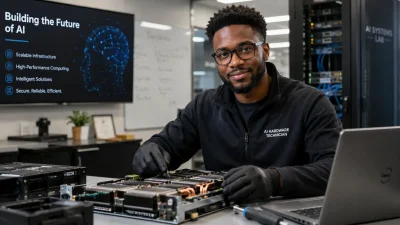
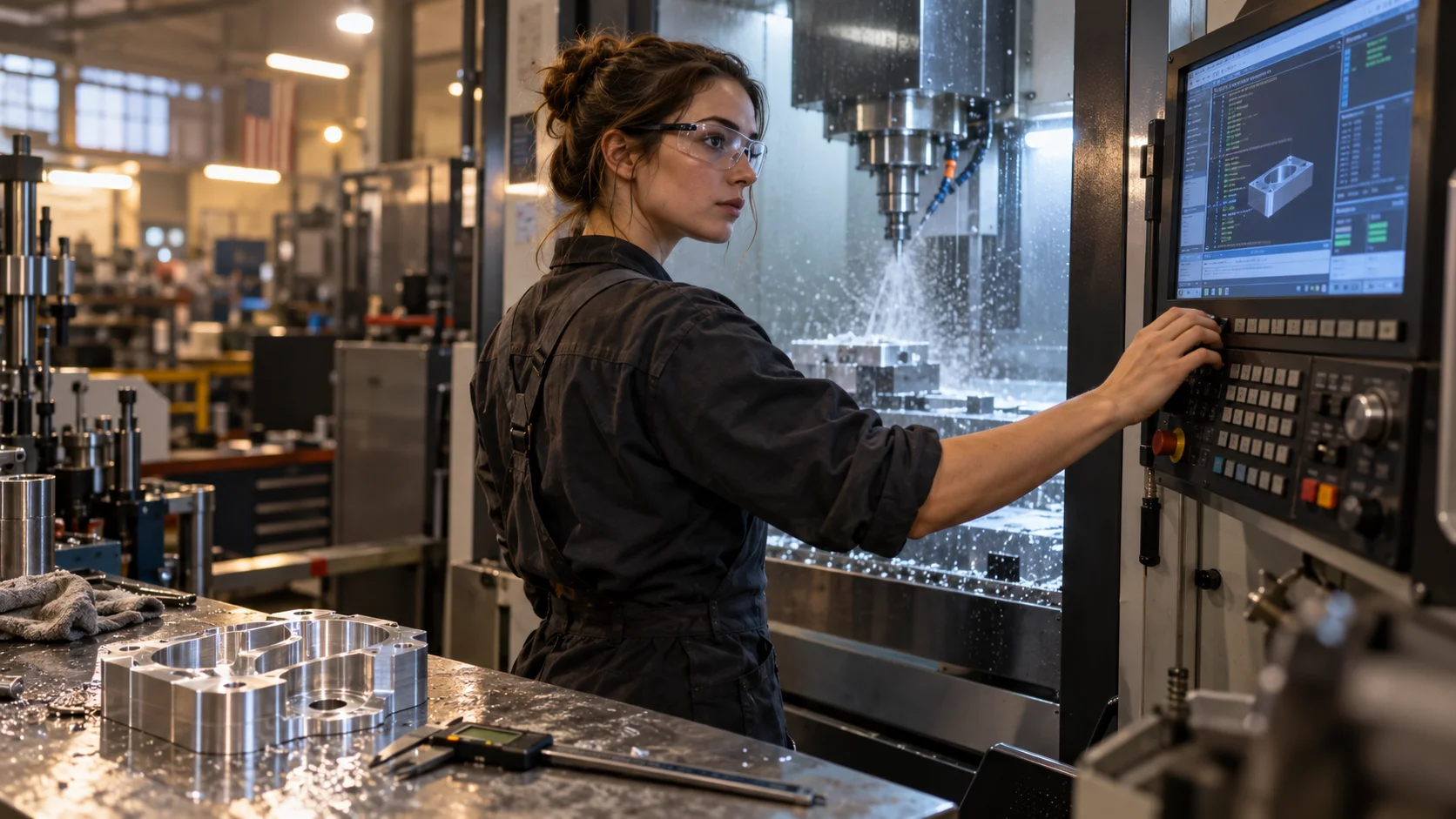
On Saturdays at the Brooklyn Navy Yard, working adults who already hold weekday jobs sit down in front of computer-controlled machining centers and learn to program them, and the training costs them nothing. Lindsay Greene, the Navy Yard's president and CEO, built the schedule around people who cannot afford to stop earning. "The trainings are both part-time and hosted on Saturdays for those who are currently employed, allowing them to participate without risking income loss," she wrote in an HR Dive op-ed in January 2025.
The skill being taught is CNC machining, short for computer numerical control, and it is automation in its most literal form. A programmed machine cuts steel, aluminum and plastic to precise dimensions, while a person writes the code, sets up the tools, checks the parts and fixes what goes wrong.
Here is the direct answer for anyone weighing the move. Machinists typically need a high school diploma and are trained on the job, and the national median machinist wage was $58,750 in May 2025. New York offers free, paid and low-cost routes into the trade from Brooklyn to Jamestown.
An Automation Job That Keeps Hiring People
The Bureau of Labor Statistics projects machinist and tool and die maker employment to slip by 1 percent between 2025 and 2035, a loss of about 2,200 jobs across a workforce of 344,900. The same BLS occupational outlook still expects about 30,400 openings every year over the decade. "All of those openings are expected to result from the need to replace workers who transfer to other occupations or exit the labor force, such as to retire," the agency writes.
The work itself has moved onto screens. BLS notes that machinists "must be comfortable using computers to work with CAD/CAM technology, CNC machine tools, and computerized measuring machines." Greene has made the same point about the industry at large: "CNC technology has become the top production method in the United States and around the globe for all manufacturing businesses today."
The trade sits beside other hands-on automation careers we have tracked, from the crews who keep Amazon's robotics running in New York warehouses to the technicians staffing the Micron chip complex rising in Clay. In each case the machines do the repetitive work, and the paycheck goes to the person who can program, tune and repair them.
What the Work Pays
BLS puts the median annual wage for machinists at $58,750 in May 2025, with the lowest 10 percent earning under $39,200 and the top 10 percent earning more than $80,010. Tool and die makers, who build the fixtures and molds that production runs depend on, earned a median of $64,050, and their top 10 percent cleared $92,680.
Those are national figures, and pay moves with shift, specialty and region. The ladder climbs from operator to programmer and from programmer to setup or tool and die work. That is why the programs below teach code and setup rather than button pushing alone.
Five Ways Into the Trade Across New York
A registered apprenticeship, statewide
New York has no state license for machinists, so the strongest credential is a registered apprenticeship. The state Department of Labor lists Machinist (CNC) among the trades approved to offer registered apprenticeships in New York, with a 48-month term. Shorter tracks include a 24-month centerless grinder apprenticeship and a 15-month CNC sawyer apprenticeship.
The state's Machinist (CNC) standard runs 8,000 hours and requires a minimum of 144 hours of related classroom instruction each year. Its work processes include 500 hours of writing basic programs and 1,500 hours of CNC machine setup. Apprentices can start at 18, or at 16 or 17 with parental approval. The Department of Labor says training is usually offered by the sponsor at no cost to the apprentice, who earns a wage from the first day.
ApprenticeNYC in the five boroughs
New York City's Department of Small Business Services runs ApprenticeNYC Advanced Manufacturing, a one-year program that trains for roles including CNC machinist, welder and industrial mechanic. It opens with a four-week pre-apprenticeship, adds 12 weeks of classroom training and finishes with 40 weeks on the job. Apprentices earn at least $18 an hour while working full time and at least $21 an hour by the end. Graduates earn the Certified Manufacturing Associate credential, and applicants must be 18 or older, live in the city and earn $50,000 a year or less.
"The Advanced Manufacturing and HVAC Pre-Apprenticeship training programs are accessible pathways for New Yorkers to enter high-growth industries where they can make a strong contribution and advance professionally and economically," Dynishal Gross, then the agency's acting commissioner, said in an August 2024 announcement.
The Brooklyn Navy Yard
The Navy Yard's CNC Machine Operator and Programmer Training is free and was accepting applications at publication, preparing students for NIMS and Mastercam certifications. An earlier programmer cohort ran 14 Saturdays from February to June 2026 and asked for one to three years of manufacturing experience, so check each listing's requirements before applying. "We are now focusing on life-sustaining, working-class careers in modern industries like CNC machining," Greene told Area Development in 2024.
Upstate certificates in Jamestown and Syracuse
SUNY Jamestown Community College offers a Machining and CNC Operator microcredential that runs 15 weeks and 320 hours. The college lists its value at $6,400 and the student cost at $2,000. It says most students receive funding for part or all of that cost through state Department of Labor Individual Training Accounts. Its most recent session ran January through May 2026 at the Cattaraugus County campus, so watch the page for the next start date.
In Syracuse, Onondaga Community College's Advanced Manufacturing Machining Certificate covers CNC programming, solid modeling and machine tools. It prepares graduates for entry-level work as machinists, apprentices, machine operators or tool grinders, and its credits carry into the Mechanical Technology associate degree.
Paid training in Rochester
The Precise CNC Machining Institute in Rochester runs a 14-week program on weekdays from 7:30 a.m. to 4 p.m. and pays trainees while they learn. Its sponsor, Precise Tool, advertises the chance to be hired after graduation, though the site does not print the training wage.
Starting Before Graduation
High school students can begin building toward the trade before they turn 18. The CDOS Commencement Credential counts career and technical coursework and work-based learning hours toward a New York diploma, and TheStandardNY's student and family guide to the CDOS credential walks through its 216-hour requirement. A shop class, a summer job at a local manufacturer and a CDOS credential together make a strong application to any apprenticeship sponsor.
Your First Three Moves
Start by deciding whether you need to earn while you learn. If you do, ApprenticeNYC, a registered apprenticeship with a manufacturer or the Rochester institute will pay you while you train. The Navy Yard and the community college certificates cost little or nothing but ask for class time.
Next, visit your local Career Center and ask about an Individual Training Account, the state voucher that covers most of the Jamestown program's cost for many students. Bring a diploma or equivalency, and brush up on shop math, since blueprint reading and measurement run on fractions, decimals and geometry.
Finally, aim for a credential employers already recognize. NIMS certifications, Mastercam training and the Certified Manufacturing Associate all appear in the programs above, and a completed registered apprenticeship carries a state Department of Labor certificate.
Across the United States, BLS counts about 30,400 machinist and tool and die openings a year, nearly all created by people leaving the trade. The Navy Yard's Saturday sessions and the four-year apprenticeship lead to the same kind of job on the shop floor.