
On July 9, a crew in the Town of Clay poured the first concrete for the foundation of Micron's first Central New York fabrication plant, one quarter earlier than the schedule the company had published. Carson Henry, the senior director of program management, described the scale in the only unit that makes it legible, telling reporters that "each fab will have about four Empire State Buildings worth of concrete."
Chief executive Sanjay Mehrotra framed the day for the industry, saying the company was "pouring concrete for what will become one of the most advanced semiconductor manufacturing facilities in the world." Governor Kathy Hochul, standing on the same site, put Central New York at "the epicenter" of the American chip build out.
The company's announcement that day carried a figure that reads differently from the headline dollar amounts. Site preparation alone directed $675 million to New York based contractors, suppliers and subcontractors, and more than eighty percent of the early site work was performed by New York residents.
Underneath the ceremony sits a number that matters more to anyone reading this without a bachelor's degree. Micron has committed to 9,000 direct jobs in New York, a large share of them technician roles, and the federal government's own occupational profile lists the entry requirement for semiconductor processing technician jobs as a high school diploma or equivalent, with no prior work experience required.
The Job Is Automation Maintenance With a Different Uniform
A modern fab is a machine that runs itself and breaks constantly. Wafers move between tools on overhead transport systems without a human touching them, etch and deposition chambers run recipes measured in angstroms, and the entire operation depends on people who can read a fault code, open a tool, replace a part and bring the chamber back into specification before the queue backs up behind it.
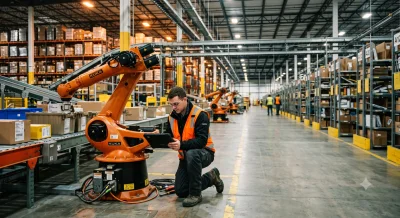
That is why the Bureau of Labor Statistics classes the work as production rather than engineering, and why its Occupational Outlook Handbook lists moderate term on the job training, running from one month to a year, as the standard preparation. The skill being hired is troubleshooting under time pressure, which is the same skill that keeps robotics maintenance technicians employed in warehouses across the state, applied to equipment that costs more than the building it sits in.
The federal outlook puts 31,200 people in the occupation nationally as of 2025 and projects eight percent growth through 2035, which the agency labels much faster than average. Those 2,600 projected positions were counted before the New York campus reaches production.
Two Salary Numbers Are Circulating, and Only One of Them Is Yours
SUNY's semiconductor programs page advertises an "average industry salary of nearly $80,000" and 280,000 new jobs expected over five years. The Bureau of Labor Statistics puts the 2025 median pay for semiconductor processing technicians at $51,430 a year, or $24.73 an hour.
Both figures are accurate and they are measuring different things. The SUNY number is an industry average that includes process engineers, equipment engineers and facilities managers holding four year and graduate degrees. The federal number is the midpoint for the specific occupation a high school graduate can enter, calculated across every fab in the country, including older facilities in lower cost regions that pay well below what a new leading edge campus offers.
Plan on the federal number and treat everything above it as earned. Shift differentials for nights and weekends, overtime during tool installs, and promotion into equipment technician and then equipment engineering technician grades are where fab compensation actually climbs, and none of that shows up in a starting offer letter.
The Training Already Exists, and It Is Small
Onondaga Community College built a semiconductor bootcamp that ran roughly three months and carried eleven students in its inaugural cohort, converting into three credits toward the college's Electromechanical Technology certificate. Professor Dave Bzdak, the faculty lead, was blunt about how it went, saying, "I've been really impressed. It's exceeded my expectations."
Against 9,000 announced positions, the pipeline currently graduating through Central New York's most direct semiconductor program would fill a fraction of one shift, which is what a genuine opening looks like before the crowd arrives.
The certificate itself is the broader door. The college describes its Electromechanical Technology track as preparing students to "work in the field of manufacturing and automation" and as "focused on troubleshooting electrical and mechanical systems," with Micron listed among its partners. SUNY runs parallel offerings across the system, including a Semiconductor Manufacturing Technology associate degree and a Semiconductor Technology certificate built for entry level processor and nanotechnology technician roles.
The Internship Is the Real Application
Eight Onondaga students spent a summer working as technicians inside Micron fabs in Boise, Idaho and Manassas, Virginia, doing equipment maintenance in paid roles that carried a relocation fee and 401(k) eligibility. Nick Hay, one of them, described the experience simply: "I loved it. Everyone I worked with was helpful and encouraging."
The eligibility rule attached to that program is the part to write down. Applicants had to be on track to graduate within a defined window, and the application closed in late January for a summer start, which means the decision that determines whether you are eligible gets made a full year before the paycheck. Enrolling in the certificate is not the last step in the process, it is the step that makes the next several possible.
The Timing Problem Nobody Announces
Micron's first Central New York fab is a multiyear build, and the company's own production milestones for this cycle point to its Idaho fabs, with first wafer output targeted for mid 2027 and late 2028. The Clay cleanroom, projected at roughly 2.4 million square feet, has to be finished, qualified and tooled before it hires at volume.
Local hiring on the construction side is already running, with veterans and small businesses named as priorities in the state's own accounting of the project. Construction work and fab operations are separate labor markets with separate credentials, so a laborer pouring concrete this year is not on a conveyor belt toward a cleanroom badge in 2029, and treating the two as one career path is the mistake most likely to cost someone three years.
The technician jobs Micron is filling today sit in Boise and Manassas, the training programs in Onondaga County are running now with small cohorts, and the wave of local hiring arrives on the far side of a credential that takes a year or less to earn. People who wait for the Clay job postings will be competing against people who spent that year in a lab.
What to Do in the Next Ninety Days
Get the certificate application in at Onondaga or at the SUNY campus nearest you, and ask the admissions office directly which of their courses articulate into the semiconductor sequence, because the answer changes by campus and by semester. Ask the same office about federal aid for short term programs, since Workforce Pell now reaches training as short as eight weeks and most people who qualify do not know it.
Then treat the internship calendar as the real deadline rather than the graduation date. Applications for the following summer close in January, the roles are paid, they place you inside a working fab, and they are the shortest documented path from a Central New York classroom to a Micron badge.
New York State has committed public money against 50,000 projected jobs and Micron has committed $100 billion over twenty years. The entry requirement for a meaningful share of that hiring remains a high school diploma, one certificate and the willingness to apply before the concrete cures.