
On September 17, 2025, Governor Hochul's office announced eleven internet service providers had won awards to wire nearly 54,000 unserved and underserved locations across New York, a package worth more than $636 million once $245 million in provider matching funds was added to $391 million in state awards. Empire State Development President and CEO Hope Knight framed the goal plainly in that announcement, saying the state would "reach the final one percent of unserved households and ensure they are not left behind."
Somebody has to pull the cable, splice the strands, terminate the connectors, test the loss budget and climb the pole. New York's ConnectALL Office reports the state has been allocated more than $664 million through the federal Broadband Equity Access and Deployment program, with the state's Final Proposal approved by NTIA on December 4, 2025 and cleared by NIST on January 16, 2026, carrying a grant cap of $14,500 per location.
The people who will do the work do not need a bachelor's degree, and in most cases they do not need an associate degree either. What they need is a certification that four New York campuses teach in a single week.
The credential, and where New York teaches it
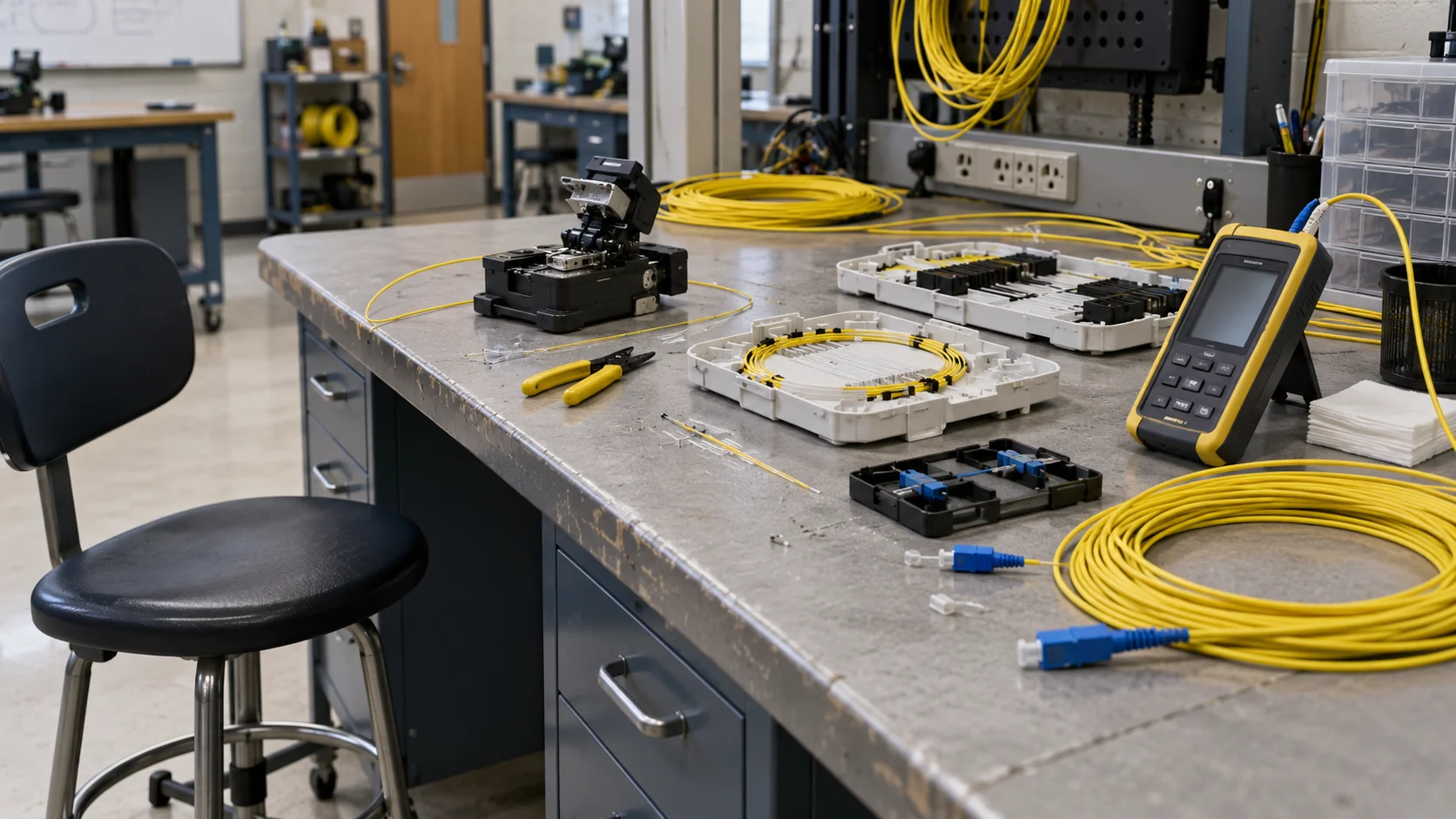
The entry credential in this trade is the CFOT, or Certified Fiber Optic Technician, issued by the Fiber Optic Association. BDI DataLynk runs its FiberOptiX Bootcamp at four New York locations, all of them public colleges: Kingsborough Community College in Brooklyn, Westchester Community College in Valhalla, SUNY Ulster in Kingston, and SUNY Broome in Binghamton. The program awards "Three FOA certifications in one week: CFOT + CFOS/T + CFOS/S," bundling the base credential with a testing specialty and a splicing specialty, and two further specialist tracks covering outside plant and fiber to the home are scheduled at SUNY Ulster.
Nationally, intensive CFOT programs run three to five days at costs between $650 and $2,000, which is the rare workforce credential that costs less than a month of rent in most of the state. The FOA describes the trade without ceremony on its own workforce pages, writing that "Fiber optic installation is not 'rocket science,' it's a trade that can be learned in a 'boot camp.'"
That organization has certified roughly 90,000 technicians to date and has watched entire regional workforces appear from nothing. In Kentucky, where the FOA notes there were practically no fiber technicians before 2016, affiliated schools trained and certified 1,200 CFOTs over five years. The same pages describe retraining laid-off coal miners into fiber techs, which is a fair description of what a fiber optic technician certification is designed to do.
The shortage is measured, not asserted
The Fiber Broadband Association and the Power and Communication Contractors Association put the industry's need at 178,000 workers through 2032, a figure that splits into roughly 58,000 genuinely new positions and about 120,000 replacements for people expected to retire or leave. Replacement demand is the half that job seekers routinely ignore and hiring managers never do, because a retirement wave creates openings whether or not the industry grows at all.
The FOA's read on the federal spending is blunter: government funded programs like BEAD and the rest of the infrastructure law "will probably more than double the amount of fiber optic work in the US." New York's $664 million is one state's slice of a $42.45 billion national program, and the per-location grant cap of $14,500 exists precisely because the remaining locations are the expensive rural ones where cable runs long distances to serve few homes.
Federal money arrives on a schedule set in Washington, and the state cannot spend it slowly without risking it, so the pressure on providers to staff up runs against a clock rather than against a market forecast. Workers who certify while the builds are being staffed enter at a moment when contractors are competing for licensed hands, which is the opposite of the position most entry-level candidates occupy.
What the work pays
The Bureau of Labor Statistics lists telecommunications technicians at a median annual wage of $66,200 as of May 2025. That is the middle of the trade rather than its ceiling, and the adjacent occupation shows where the ceiling sits: electrical power-line installers and repairers earn a median of $95,320, hold 131,900 jobs, and are projected to grow ten percent between 2025 and 2035, which the BLS classifies as much faster than average, with roughly 10,900 openings each year. Both occupations list a high school diploma as the typical entry requirement and both rely on long-term on the job training.
We have written about that adjacent ladder before in our reporting on what New York pays line workers and why nine in ten openings exist because somebody retired. Fiber sits one rung across rather than one rung down, and technicians move between the two more often than the job titles suggest.
How people actually get in
Three routes lead into the trade and they are not equally advertised. The first is a bootcamp certification paid out of pocket, which is the fastest and the one most visible on a search engine. The second is a union apprenticeship, and the FOA specifically names IBEW locals among the organizations running them, where training is paid rather than purchased. The third is direct hire by a contractor who sends new workers to certification after they are already on payroll, a pattern the FOA calls Work-to-Cert for people with related field experience.
The contractors doing BEAD-funded builds are the employers to watch, because subgrantee obligations under the program force deployment on a schedule. A provider that won an award for a rural county in September 2025 has crews to assemble, and those crews are being assembled now rather than in 2028.
The same calculation that governs any training decision applies here, which is whether the credential is worth what it costs against what it returns. Our education desk has covered the federal earnings threshold New York programs now have to clear, and a one-week certification under $2,000 against a $66,200 median clears that bar by a distance no four-year program in the state can match on time to earnings.
What the job is really like
Fiber work is outdoor work, physical work, and often work at height or in a trench. Splicing demands steady hands and clean technique, because a poor fusion splice shows up as loss on an OTDR trace and gets found. Testing demands the discipline to document a loss budget that somebody will audit later. Weather does not stop a build schedule, and rural deployment means driving.
What it does not demand is four years and tuition debt. The BEAD broadband buildout in New York is a construction program with a deadline attached, and construction programs hire from wherever the certified people are. Those people are being made this fall at Kingsborough, Westchester, SUNY Ulster and SUNY Broome, five days at a time.
For readers weighing this against other doors we have covered, the pattern is familiar from our work on earn-while-you-learn cyber apprenticeships: the credential is short, the employer is under pressure, and the degree requirement was never really there. New York has $664 million to spend on cable that does not lay itself.