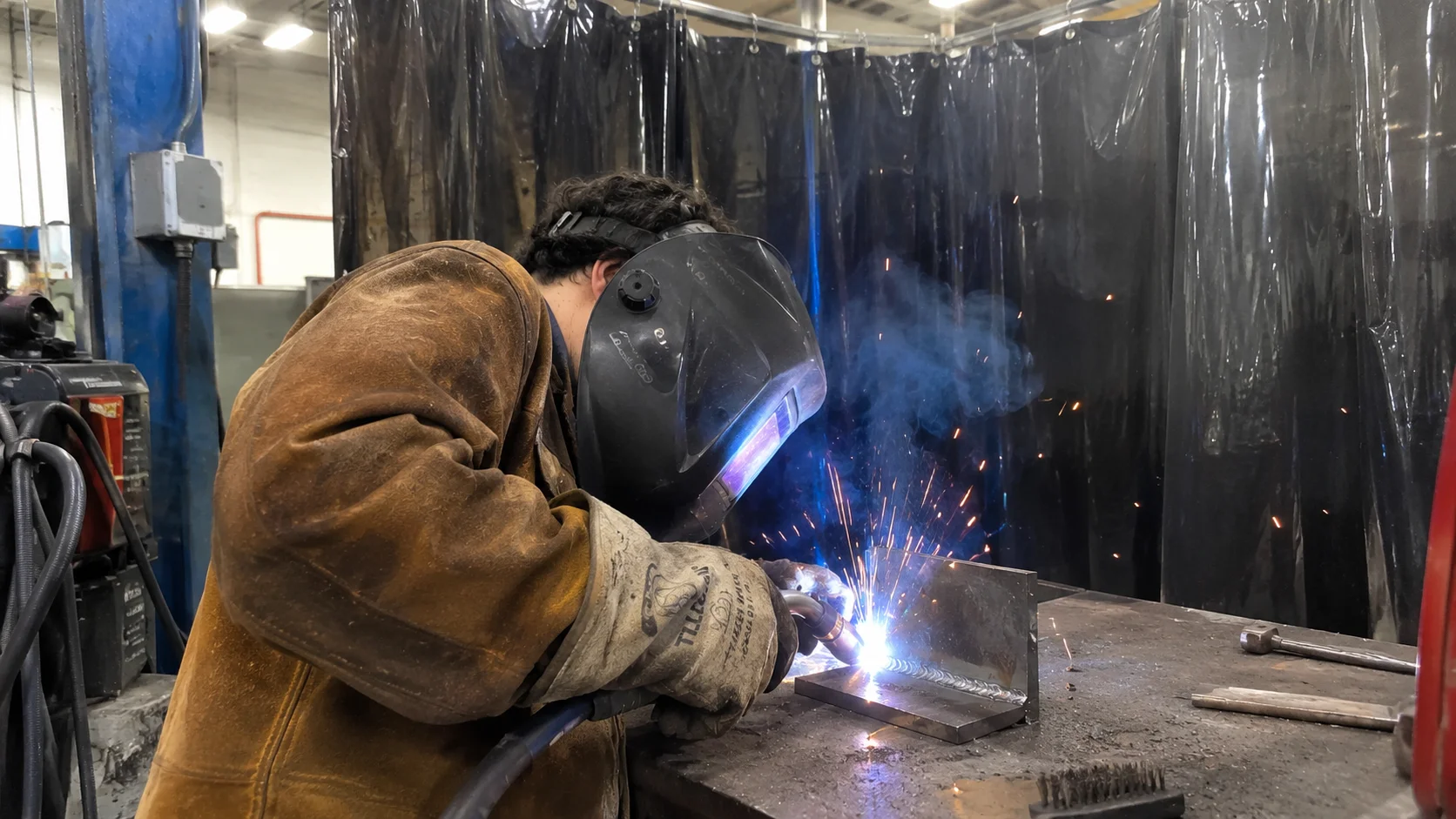
A welding test plate looks unremarkable when it comes out of the booth, two pieces of steel fused along a seam, still warm, with a bead that is either even or not. An inspector then cuts strips from that plate and bends them, and if the weld cracks or opens, the welder starts over. No transcript enters the room, and no one asks about a grade point average.
According to the Bureau of Labor Statistics' Occupational Outlook Handbook, welders, cutters, solderers and brazers earned a median pay of $53,750 in May 2025, or $25.84 an hour. The typical entry requirement is a high school diploma or its equivalent, and the occupation counted 437,700 jobs in 2025.
The growth projection is modest, 2 percent from 2025 to 2035, which BLS rates slower than average. The openings are not modest. The agency expects about 40,300 a year across the decade, most of them created when current welders move into other occupations or leave the labor force. That replacement math has also driven several of the no-degree careers in New York this site has profiled.
Where the Paychecks Land
Manufacturing employs 63 percent of welders and paid a median of $51,210 in May 2025, while specialty trade contractors, the firms that handle structural steel, piping and building work, paid $59,440. Merchant wholesalers of durable goods came in at $50,290, and administrative, support and waste management services at $48,810.
That spread matters in a state with both an upstate factory base and a downstate construction market. A welder who learns on production work in the Mohawk Valley and later moves into commercial construction in the city follows a path the federal data already maps. The certifications and city licensing described below are part of what that move requires.
BLS also counts self-employed workers at about 4 percent of welding jobs. In rural New York, independent work can mean mobile repair or a small fabrication shop, where a truck-mounted rig and a reputation can become a business.
Training Without a Degree
Formal programs compress the learning curve, though BLS notes that even entry-level workers with technical training receive several months of on-the-job training once hired. In Watertown, SUNY Jefferson runs a 22-week welding program across two semesters with 126 contact hours in total. Welding I runs 13 weeks and costs $4,232, and Welding II runs eight weeks and costs $3,194, bringing the full program to $7,426.
The college states that "there are no additional costs students are expected to incur as a result of enrolling in the educational program," and it lists a limited Classroom Training Grant and VA educational benefits as possible funding. Students who finish Welding I can pursue NCCER Welding Level I, and those who finish Welding II can pursue Level II, credentials from the national construction-industry training curriculum.
Program length matters for financial aid. Federal Workforce Pell grants cover short programs only within set ranges of hours and weeks, which our guide to Workforce Pell lays out. Any welding course should be checked against those limits before a student counts on the money. TheStandardNY's reporting on which New York programs have won approval is the place to confirm a specific program.
Students still in high school have another door. BOCES career and technical programs in many regions teach welding, and those hours can count toward the state's CDOS Commencement Credential, which TheStandardNY explained in its guide to the 216-hour credential.
Prospective students can sort programs with a short set of questions before paying a deposit. Whether the school is itself an AWS-Accredited Testing Facility determines if the certification test happens on site or somewhere else. Which processes the booths are equipped for, how many hours a student spends welding rather than in a classroom, and whether employers recruit graduates directly are all answers a program should give in writing.
Cost comparisons should include consumables such as rods, wire, gas and protective gear, since some programs fold those into tuition and others bill them separately. SUNY Jefferson's statement that students face no additional costs is the kind of line worth asking every other school to match.
The Credential Employers Ask For
Welding certification is a performance exam rather than a written one. The American Welding Society's AWS Certified Welder program is performance-based, requires no prior classes or credentials, and is administered by appointment at AWS-Accredited Testing Facilities, many of them housed at community colleges and training centers. A welder tests to a specific process, position and material, so a certification earned on flat carbon steel plate does not automatically cover overhead pipe.
BLS notes that some employers require certification for particular jobs and may pay for the training and testing. Welders must also be licensed in some states and localities, and OSHA requires welders to complete electrical safety training. A worker who can show a current certification at the interview walks in with the same proof an employer would otherwise have to generate in its own shop.
Specialized codes open different doors. Structural steel, pressure piping and pipeline work each run on their own qualification standards. Stacking certifications across processes such as stick, MIG and TIG is how a welder moves from production pay toward the contractor rates in the federal data.
The New York City Card
Inside the five boroughs, anyone who runs a torch using oxygen and a flammable gas needs a Certificate of Fitness from the Fire Department, known as the FDNY G-60. The same certificate is required for torch-applied roofing systems, and it belongs to the individual who earns it rather than to the employer.
The process is short. Applicants apply in person with two forms of identification, one of them a government-issued photo ID, plus a completed application and a letter of employment, and then pass a written exam. The application fee is $25, renewal costs $15, and the certificate must be renewed every three years. Applicants who pass receive the certificate right after the exam, and the Fire Department posts study materials for the G-60 test on its website.
The letter-of-employment requirement shapes the order of operations for a new welder in the city, since the card generally follows a job offer rather than preceding it. That sequence makes the first employer's backing part of the credential, and it is one more reason the performance certification earned beforehand carries so much weight in the hiring conversation.
How the Path Fits Together
For a New Yorker starting from a diploma, the route runs through a semester or two of training at a community college or BOCES adult program and a performance test at an accredited facility. A first job in production or fabrication follows, and in the city, so does a G-60 once an employer letter is in hand. Readers comparing options can set it beside our profile of CNC machinists, the other metalworking trade that hires on demonstrated skill.
The ceiling depends on what gets stacked on top of that first certification. Each new process, position and code widens the pool of jobs a welder can bid on. The gap of more than $8,000 between the federal medians for manufacturing and specialty contracting marks where that stacking tends to lead.