
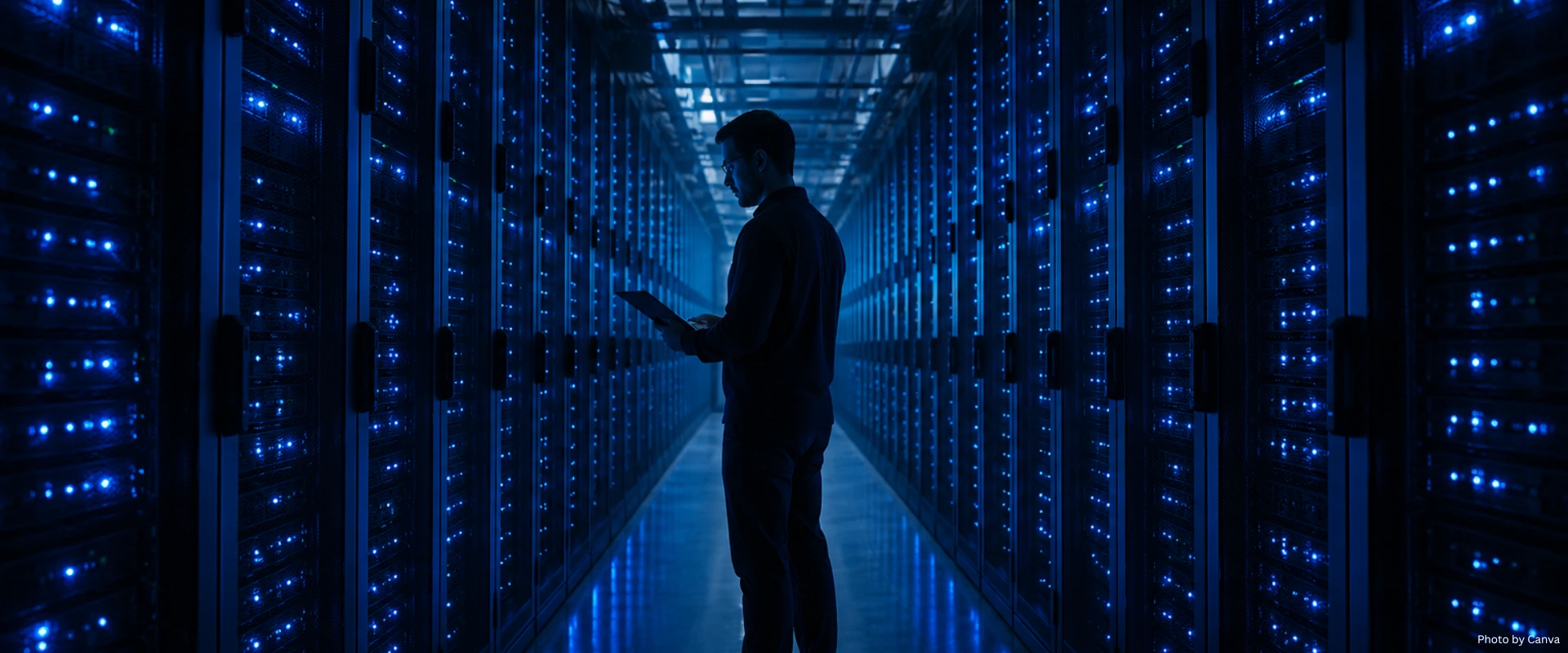
The AI infrastructure boom has created massive demand for data center technicians across New York — the people who physically install, operate, and maintain the hardware that powers the internet. Entry-level roles start at $60K+, experienced techs earn $86K on average, and top earners clear six figures. The certifications that get you hired are accessible, fast, and affordable.
Most conversations about the AI economy start and end with the screen: who is writing the prompts, who is training the models, who is building the apps. But there is another layer to this story that almost nobody is talking about — a physical layer, made of steel racks, blinking drives, and climate-controlled rooms that never go dark. Every AI system you have ever used runs on hardware housed in a data center. And right now, the people who operate and maintain that hardware are in critically short supply, especially in New York.
The data center technician is one of the most in-demand, most underpublicized roles in the modern tech economy. It pays well, it does not require a four-year degree, and the certification path is shorter and cheaper than most people expect. If you are looking for a way into the infrastructure of the AI era without going into six figures of student debt, this is one of the most direct routes available to you right now.
To understand the scale of what is happening right now, you need to understand the money flowing into AI infrastructure. The five largest tech companies — Amazon, Google, Microsoft, Meta, and Apple — are collectively projected to spend over $600 billion on GPU and data center infrastructure through 2026. The Stargate Project, a joint venture between OpenAI, Oracle, and SoftBank, has committed $500 billion over four years to building new AI data centers across the United States. These are not abstract projections. Buildings are going up. Power grids are being upgraded. Cooling systems are being installed. And every single one of those facilities needs trained technicians to operate it.
New York Is Building the EV Grid: Here's How to Get Paid to Wire It
New York is directly inside this wave. TeraWulf is expanding its Lake Mariner data center campus in western New York, with its CB-5 building expected to come online in the second half of 2026 — backed by a 200-megawatt lease with AI infrastructure firm Fluidstack, itself backed by Google. Equinix, one of the world's largest data center operators, has maintained a significant New York presence for years and continues to expand. The demand for workers to staff these facilities is not a future projection. It is a current, active shortage.
AI is amplifying pressure across every skilled labor pool. Data center technicians are being competed for by utilities, construction, renewables, and grid infrastructure all at once.
According to the AFCOM 2025 State of the Data Center Report, 58 percent of data center managers identified multiskilled operators as the top area of growth, and 50 percent signaled increasing demand for data center engineers. Security specialist roles tied to data center operations reached nearly 67,000 job postings in 2025 alone — up 124 percent year over year. The labor pipeline is not keeping pace with the buildout.
The job title sounds technical, and the work is — but it is hands-on technical work, not screen-staring technical work. A data center technician is responsible for the physical layer of computing infrastructure: installing and racking servers, running and managing cables, monitoring environmental systems like power and cooling, performing routine hardware maintenance, responding to equipment failures, and troubleshooting issues that affect the availability of systems running inside the facility.
Think of it as the operational backbone of every cloud service, streaming platform, banking system, and AI application that New Yorkers interact with every day. The work happens in shifts, because data centers run 24 hours a day, 365 days a year. Downtime is not acceptable — which is exactly why the people who prevent it are compensated at a rate that reflects that responsibility.
The physical demands of the role are real: you will lift equipment, crawl under raised floors, manage cable runs in tight spaces, and work in environments that are kept extremely cold to protect the hardware. The mental demands are equally real: you need to read system alerts intelligently, understand how a failure in one component can cascade through connected systems, and document everything with precision. This is not passive work. It is skilled, essential, and non-outsourceable — you cannot remotely swap a failed hard drive or physically re-seat a server from across the world.
Data center technician salaries in New York City average $86,497 per year — about 8 percent above the national average for the role. The typical pay range runs from roughly $59,000 at the entry level to over $91,000 for experienced technicians, with top earners at major employers like Google and financial services firms reporting salaries approaching $111,000. Entry-level technicians with one to three years of experience average around $49,000 to $65,000 — competitive starting pay for a role you can qualify for without a college diploma.
The growth curve matters too. A technician who moves into a senior data center operator or lead technician role can expect to clear $80,000 to $83,000. Those who develop specializations in power systems, cooling infrastructure, or network operations move into engineer-level compensation that pushes well past six figures. By 2026, permanent data center employment in the U.S. is projected to reach 650,000 positions — and the qualified candidate pool is nowhere near that number.
Beyond the Degree: How to Build a Six-Figure Cybersecurity Career
Employers in this space are not looking for diplomas. They are looking for verifiable, specific credentials that prove you understand the hardware and the environment. Here are the three that carry the most weight at the entry and mid level:
CompTIA A+ — Your Starting Point
The CompTIA A+ is the foundational IT certification that most data center employers treat as the baseline expectation for any technical hire. It covers hardware troubleshooting, networking fundamentals, operating system support, and security basics. You do not need prior experience to sit for it, and the exam fee is around $253 per voucher. It is the first credential that signals to an employer that you understand the physical and operational basics of IT infrastructure.
CompTIA Server+ — The Data Center Specialist Credential
The CompTIA Server+ is the credential that specifically validates your competency in server environments and data center operations. It covers the full server lifecycle — installation, configuration, storage, security, disaster recovery, and decommissioning — and is one of the few certifications that directly tests physical data center skills like racking, cabling, and environmental controls alongside virtualization and cloud knowledge. The exam voucher runs about $369, and the certification is valid for life with no recertification required. According to Skillsoft data, the Server+ credential is associated with average salaries of $108,000 globally. Boot camp programs that include the exam voucher are available for around $1,200 to $1,500.
DCCA — The Entry-Level Infrastructure Credential
The Data Center Certified Associate (DCCA), offered by Schneider Electric through their Energy University platform, is an accessible entry-level certification focused specifically on physical data center infrastructure — power systems, cooling, rack layout, cabling, fire protection, and physical security. It requires no prerequisites, costs approximately $250 for the exam, and can be completed within one to two months of self-paced study. For someone with no prior IT background who wants to break into data center operations, the DCCA is one of the most practical starting points available.
The stack that works: CompTIA A+ to establish your baseline, DCCA to demonstrate physical infrastructure knowledge, and Server+ to position yourself for mid-level data center roles with a direct path to $70K-$90K+ in New York's market.
Where the Jobs Are in New York
New York City's density works in your favor here. The city is home to major data center operators including Equinix, Digital Realty, and CyberArk, along with the New York facilities of virtually every major financial institution — each of which runs its own data center infrastructure. Wall Street's reliance on low-latency, high-availability computing has made New York one of the most data-center-dense markets in the country, and financial sector data centers typically pay at the top of the market.
Beyond the city, western New York is emerging as a real data center growth zone. TeraWulf's Lake Mariner campus in Barker, New York — a former coal plant site being redeveloped into a power-rich data center campus — represents exactly the kind of large-scale infrastructure investment that generates sustained technician employment for years. These are not temporary construction jobs. They are operational roles that persist for the life of the facility.
On the hiring side, companies actively posting data center technician roles in the New York market include Google, Equinix, IBM, and a wide range of managed service providers and financial institutions. The CUNY system — specifically LaGuardia Community College and Bronx Community College — offers information technology programs that align directly with the CompTIA certification track, and WIOA-eligible workers may be able to access tuition assistance for certification programs through New York State's workforce development system.
Here is the part of this story that cuts against the usual AI narrative: the rise of artificial intelligence is not a threat to data center technicians. It is the reason they are more essential than ever. Every AI model that gets trained, every inference that gets run, every chatbot response that gets generated — all of it runs on physical hardware that lives in a physical building and requires physical human beings to keep it operational.
Gary Wojtaszek, executive chairman of Pure Data Centres, said it plainly in a March 2026 interview with CNBC: "Someone needs to man those machines, so those are really important jobs, and that is a huge challenge for the industry overall." AI is not replacing the data center workforce. It is making that workforce more necessary, more stretched, and consequently, more compensated.
AI won't replace any of those jobs. Someone needs to man those machines.
The data center technician's value is rooted in irreducible physical reality. The server doesn't know it's failing. The cooling system can't call for help. The cable doesn't re-seat itself. These are human jobs, in human-scale spaces, producing outcomes that the entire digital economy depends on — and they will remain that way for as long as the internet exists in physical form.
The AI economy needs rooms full of servers. It needs those rooms maintained, monitored, and managed by people who know what they are doing — people who show up on site, read the alerts, and keep the machines running when everything is on the line. That is the data center technician, and in New York right now, there are not enough of them.
The certifications are accessible. The training is fast. The pay is real from day one, and it scales as you build experience and specialization. If you are looking for a way into the infrastructure of the AI era — not the hype, not the theory, but the actual physical layer that makes all of it work — this is a career path worth your serious attention. The rooms are being built. The servers are going in. The question is whether your name is on the schedule when the facility goes live.