Tonight the Garden is loud. The Knicks are in the NBA Finals for the first time in a generation, the building is sold out, and seventeen thousand people are screaming at the same rim. Nobody in those seats is thinking about the people who made the night physically possible. But before tip-off, somebody pulled a basketball floor over a sheet of ice, dialed in the cooling, hung the lights and video boards, ran the power, and signed off on every rigging point above the crowd. None of them needed a four-year degree to do it. A lot of them clear six figures.
Here is the part that does not get talked about: a major arena is one of the densest collections of high-paying, hard-to-automate skilled trades jobs in any American city, and New York has more of these buildings than almost anywhere on earth. Madison Square Garden, Barclays Center, UBS Arena out on Long Island, KeyBank Center in Buffalo, and the new and renovated venues across the state all run on the same labor. These are no-degree careers with apprenticeship on-ramps, certification ladders, and union wages. If you have been told the only way up is a bachelor's degree and a desk, the building hosting the Finals tonight is living proof otherwise.
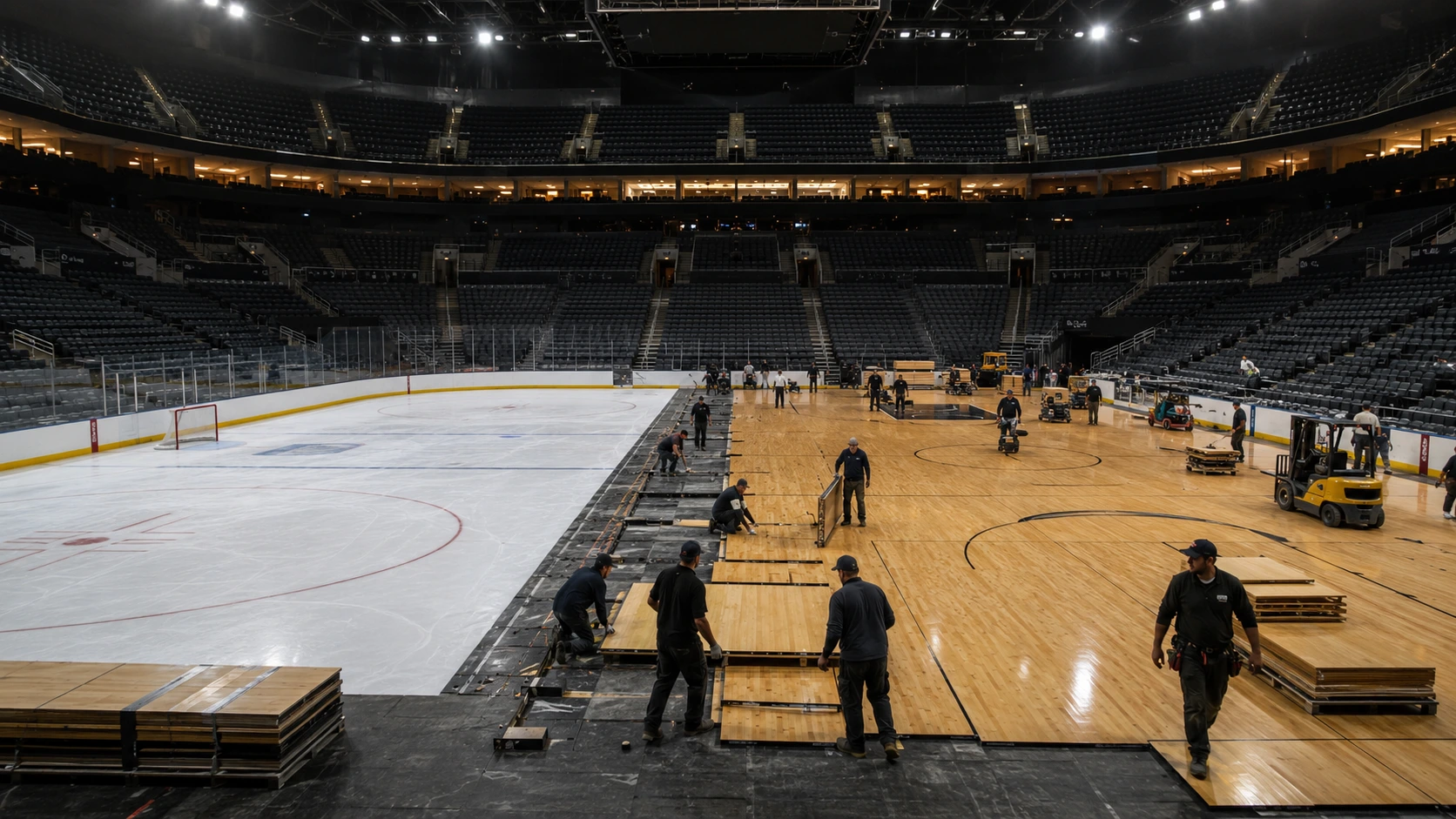
Madison Square Garden hosts somewhere north of 300 events a year, and it is the only major arena in the country where the same building flips between an NBA team and an NHL team all winter long. The trick most fans never learn is that the ice never fully leaves. The hockey surface sits under an insulated deck, chilled by a grid of pipes running through the concrete slab, and the basketball floor gets laid right on top of it. When the building needs ice again, crews pull the floor and the insulation, then spray thin layers of water onto a seventeen-thousand-square-foot surface and hand-paint the blue lines and face-off circles.
That changeover is not magic. It is a choreographed operation run by crews split into groups, each one assigned a corner, a bench area, the dasher boards, the glass, or the floor itself, working against a clock that sometimes gives them only a few hours between events. Every piece of that, the cooling, the power, the rigging, the boards, the audio, is a defined trade with a defined paycheck. Let us walk through who actually makes the money.
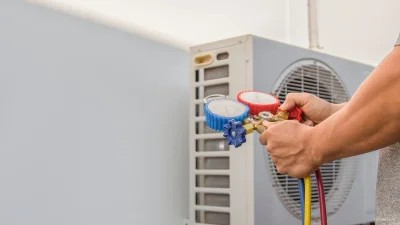
That sheet of ice exists because a refrigeration system keeps it frozen. The people who design, run, and repair those systems are HVAC and commercial refrigeration technicians, and they are some of the most quietly well-paid tradespeople in the building. In New York, HVAC techs earn a median around $66,670 a year, already above the national figure, and that number is the floor, not the ceiling. Technicians who specialize in commercial refrigeration, the large-scale cooling that runs ice plants, chillers, and rink systems, regularly push past $100,000, especially with overtime and union scale.
The entry credential is not a diploma. It is the EPA 608 certification, which federal law requires for anyone who handles refrigerants. The exam costs somewhere between $20 and $150. Trade-school programs run six months to two years, and many people earn while they learn through an apprenticeship. This is the through-line of the entire Skilled Boom: you stack a real credential, you get on a job, and your pay grows with your hands, not your transcript.
The ice under the Knicks floor is not an accident of weather. It is a refrigeration system, and somebody with an EPA 608 card and a few years of commercial experience is the reason it stays frozen through a sold-out Finals game.
An arena on game night is one of the most electrically demanding spaces in the city. Court lighting, the scoreboard, broadcast feeds, concessions, and the cooling plant all draw enormous load, and all of it has to be installed, balanced, and kept safe by licensed electricians. In New York City, that work largely runs through IBEW Local 3, and the wages tell the story. First-year apprentices start around $22 an hour base and can earn $35 to $48 an hour on prevailing-wage jobs. A journeyman electrician in the city averages well over $100,000, with top earners reported near $179,000.
The on-ramp is an apprenticeship, and the requirements are refreshingly plain: you generally need to be eighteen, hold a high school diploma or GED, pass a basic math aptitude test, and clear a drug screen. No prior trade experience is expected, because teaching you the trade is the entire point. New York's prevailing wage law sweetens the deal further: on public works projects like schools, transit, and hospitals, even apprentices earn rates often ten to twenty dollars an hour above the private-sector equivalent. This is the same cert-and-apprenticeship logic that is opening doors across other booming New York sectors right now, including the EV charging infrastructure build-out that is actively hiring electricians across the state. Power is power, whether you are wiring a charging hub or feeding a Finals broadcast.
Look up. Everything above the court, the speaker arrays, the lighting trusses, the center-hung scoreboard, is suspended by riggers who calculate load and certify that nothing comes down. In New York, much of this live-event work runs through IATSE Local One, the stagehand and technician union that crews Madison Square Garden, Radio City, the major broadcasts, and Broadway. What makes this path unusual is that Local One contracts are open shop, meaning anyone who can actually do the work can be hired. You earn your way toward full membership by logging real earnings on union contracts, and the apprenticeship program trains across lighting, sound, rigging, carpentry, and emerging show technology. Union scale on this work runs far above the non-union rate, and skilled riggers and audio techs in major markets routinely command premium pay.
Then there is the screen everyone stares at all night. The center-hung video board and the ribbon displays are run and maintained by LED video board technicians, a role that sits at the intersection of the trades and the broader technology economy. It is part of the same physical-tech wave reshaping the regional job market, the one we mapped in our look at New York's data center technician shortage. Screens, servers, and stadium tech all need human hands on site, and those hands are in short supply.
The thing these jobs share, and the reason they belong at the center of the Skilled Boom, is that they are AI-resistant careers by their nature. A language model cannot recharge a refrigerant line, pull a rigging point, balance an electrical panel, or skate out and hand-paint a face-off circle three hours before a Finals game. The work is physical, on-site, and live, with a hard deadline and a packed building depending on it. Automation is reshaping plenty of white-collar fields, but it is not flipping the Garden from hockey to hoops. That is precisely why these trades hold their value, and why they pair so well with the indoor, screen-based no-degree paths like the cybersecurity track we broke down for the Digital Boom. Different buildings, same principle: skills and certifications beat a diploma you spent four years paying for.
Pick your lane and chase the credential, not the degree. For the cooling side, enroll in an accredited HVAC program at a SUNY or community college, where in-state tuition can run a few thousand dollars, and sit for your EPA 608 exam. For power, apply to the IBEW Local 3 apprenticeship and be ready for a waitlist; the New York locals pay the most in the country, which is exactly why the line is long. For the show side, sign up for the IATSE Local One apprenticeship test window and start logging hours. None of these paths asks for a transcript. They ask whether you show up, learn fast, and can be trusted around a live building.
If you would rather build something of your own once you have the skill, a trade license is also a business license waiting to happen. Plenty of New York technicians turn a few years of arena and commercial experience into an independent service company, and the practical playbook for standing up that kind of small operation, from a simple site to the back-office tools, is the sort of thing our partners at HelpWebmasters.com cover for first-time founders. The mindset shift from clocking in to running the show is the same one the Infinite Mindset team at Infinity Agent Solutions writes about for any career pivot: bet on the skill, then bet on yourself.
The Knicks Finals run is giving the whole city a reason to look at Madison Square Garden again. Look a little harder. The building is a working monument to a truth Sonic Boom keeps hammering: in New York, some of the most stable, best-paid, most future-proof work happens in coveralls, not in a cap and gown. The ice plant operator, the union electrician, the rigger, and the refrigeration tech are not in the background of the Finals. They are the reason there is a Finals to watch. And the door into their world is open to anyone willing to earn a certification and put in the reps.