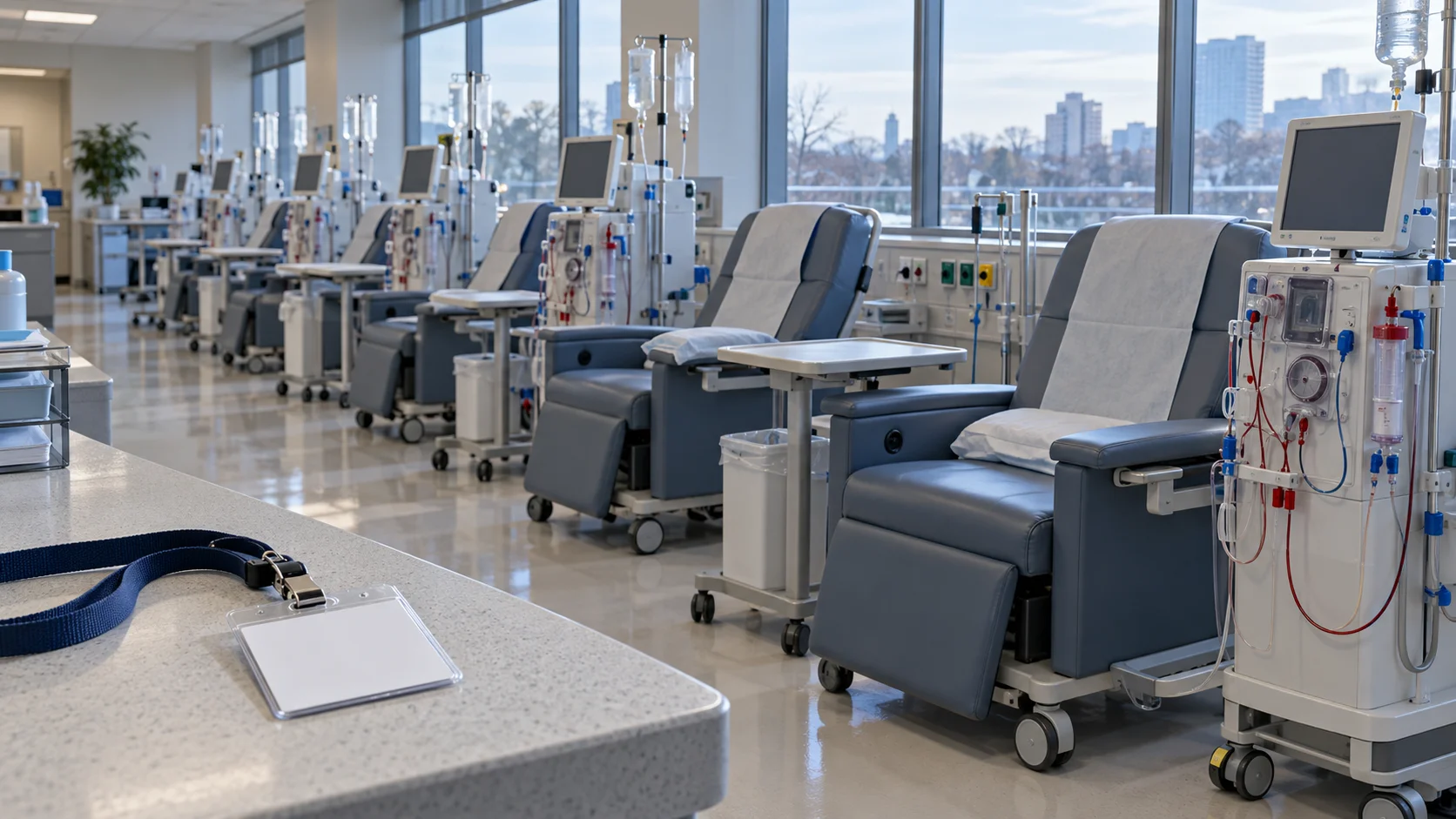
There are 345 Medicare-certified dialysis facilities in New York State, and the people who spend the most hours beside the machines in them hold no New York license at all. The state did not forget to write one. It decided the federal rule was enough, which leaves an opening that almost nobody explains out loud: in this job you are hired first, paid from the first week, and certified inside eighteen months.
That sequence is unusual in healthcare. Most clinical doors in New York open only after you have paid tuition, finished a program and passed a licensing exam, and the bill arrives long before the paycheck does. The dialysis patient care technician role runs the order backwards, and the regulation that makes it possible is public, short and worth reading before you believe anything a career site tells you about it.
What the rule actually says
Federal regulation 42 CFR 494.140 requires that a patient care technician in a dialysis facility have a high school diploma or equivalent, complete an approved training program covering dialysis principles, patient care, water treatment, infection control and safety, and then be certified "under a State certification program or a national commercially available certification program," which for a new hire means "within 18 months of being hired as a dialysis patient care technician."
New York adopted that standard rather than building its own. Section 757.3 of the state health regulations requires technicians to be certified by a CMS-approved national certification organization within eighteen months of hire, to complete a training program approved by the facility's medical director, and to work under registered nurse supervision, since it states that all unlicensed staff with patient care responsibilities must be supervised by RNs.
Some career guides describe certification for this job in New York as optional. The regulation says otherwise, in both the federal and the state text, and a technician who reaches month nineteen without a credential is a compliance problem for the facility that hired them. The clock is generous and it is not decorative.
The credential and what it costs
Two dialysis technician certification bodies dominate. The Nephrology Nursing Certification Commission issues the Certified Clinical Hemodialysis Technician credential, requires a high school diploma or GED and completion of a training program with classroom and supervised clinical components, and charges $225 for the exam. The test runs 150 questions over three hours, and the commission states that passing means answering 74 percent of the questions correctly. Six months and a thousand hours of clinical experience are recommended rather than required.
BONENT issues the Certified Hemodialysis Technologist credential and takes a different route in, asking for six months of nephrology patient care experience and active participation in an ESRD facility, or an application within two years of finishing a BONENT-approved program for candidates with no experience. Its exam runs $235 on paper and $255 by computer, with two signed reference letters required.
Against the cost of almost any other clinical credential in this state, those are rounding errors, and an employer that pays for the exam turns the number into zero.
Who is hiring, and what they say in writing
Fresenius Medical Care answers the experience question directly in the FAQ on its own patient care technician careers page. Asked whether applicants need dialysis experience, the company answers: "No. We offer a comprehensive, paid training program. Many successful PCTs start without any prior dialysis experience." The same page lists paid training, mentorship, education support and tuition reimbursement among the benefits, and names the CCHT credential as the next step on the ladder.
DaVita's careers page takes the softer route of testimonial, and the most useful one comes from the top of its own clinical organization. Tina Livaudais started there as a patient care technician and is now the company's chief nursing officer. "Now, as chief nursing officer, it's important to me that our teammates have the same experience," she writes. A current technician identified only as Bobbie puts the same arc in one sentence: "Becoming a nurse at DaVita has been a huge dream of mine."
Training exists outside the employers too. Nassau Community College's workforce development arm lists a dialysis technician course of 70 instructor-led hours at $1,895, taught on Friday evenings and Saturday mornings and aimed at the BONENT exam. For someone who wants the classroom before the interview, that is a two-month commitment at community college prices.
The number nobody can give you honestly
Dialysis technicians have no standalone federal occupation code, which means no agency publishes a wage for them. They are folded into SOC 29-2099, Health Technologists and Technicians, All Other, a catch-all that also holds neurodiagnostic technologists and ophthalmic medical technologists. The New York median for that whole bucket is $60,320 a year, or $29.00 an hour, on May 2025 federal wage data, with the tenth percentile at $41,380 and the ninetieth at $97,280.
The higher-credentialed occupations inside the bucket pull the median up. A New York health careers profile maintained by the Center for Health Workforce Studies puts dialysis technicians closer to $48,500 at the median and $38,566 at entry, though it sources those numbers to a private salary survey and attaches no year to them.
The useful conclusion is not a salary figure. It is that this job pays like a skilled clinical support role in an expensive state, that the range is wide, and that the certification you earn on your employer's clock is what moves you through it. Anyone being told a precise number by a jobs aggregator is being told an estimate dressed up as a fact.
Why the demand is not going anywhere
The federal dialysis system counted 516,837 patients on dialysis across its eighteen ESRD Networks as of March 31, 2025, served by more than 7,500 facilities. New York's 345 of them, counted from the CMS dialysis facility file updated in June 2026, are spread across the state rather than clustered in one metro, which matters for anyone who cannot move for work. In 2019 a state industry association counted 305 New York facilities, so the network has grown while the workforce pipeline has not.
Most in-center patients come three times a week, every week, indefinitely, and each chair requires staff on a schedule that cannot slip. That is the structural reason the entry door stays open and the reason employers pay to train people who walk in with nothing but a diploma.
The rung above, and what it costs in New York
The technicians quoted above are both describing the same next step, and New York prices it clearly. The state's licensed practical nurse requirements ask for a NYSED-registered program, passage of the NCLEX-PN, infection control coursework, a minimum age of seventeen, and a licensure fee the state states plainly: "The fee for licensure and first registration is $143."
LPN training in New York is where the money goes, and where the state is wildly inconsistent. Orange-Ulster BOCES runs 1,104 approved instruction hours over ten months full time and charges $16,493 for 2025-26. Capital Region BOCES estimates $27,715 all in for 2026-27, with roughly $2,900 of books and testing materials on top of tuition and an explicit warning that financial aid does not cover books, uniforms and other fees. The same license, the same exam, and about $8,000 of difference depending on which BOCES you drive to.
Loretto, the Syracuse-area long-term care provider, runs an LPN apprenticeship with 1199SEIU that pays apprentices while they train, covers tuition, runs eleven months and guarantees employment at the end. The program reports 49 graduates since 2018, a 96 percent NCLEX pass rate, and an investment of more than $65,000 per student from the employer and the union training fund.
New York's median for licensed practical nurses sits at $67,180 a year on the same May 2025 federal data, against a national median of $64,400 reported in the Bureau of Labor Statistics handbook, which lists the typical entry credential for the occupation as a postsecondary nondegree award and the typical on-the-job training as none.
The move, in order
Get hired into a clinic that outlines paid training in writing. Take the CCHT or the CHT inside the eighteen months the regulation allows, and ask in the interview whether the employer covers the exam fee, because several do. Bank the clinical hours, which count toward the next credential in a way that retail or warehouse hours never will. Then decide whether the LPN ladder is worth ten months at a BOCES, or whether an apprenticeship that pays you through it is within driving distance.
New Yorkers who want the same structure in a different clinical setting should look at the sterile processing and surgical technology route, which runs on a similar logic of short credential and immediate hospital demand. Those weighing whether federal money will cover a short program should start with the new Workforce Pell rules, which opened to programs as short as eight weeks on July 1 of this year. High school students still deciding whether to stack a credential before graduation can compare this path against New York's work-based learning credential, which builds the same kind of documented clinical hours inside a school schedule.
Three hundred forty-five clinics in this state run on chairs that cannot sit empty, staffed by a job the state never licensed and the federal government gives you a year and a half to certify into. The door is open now, and it is paid from the first shift.