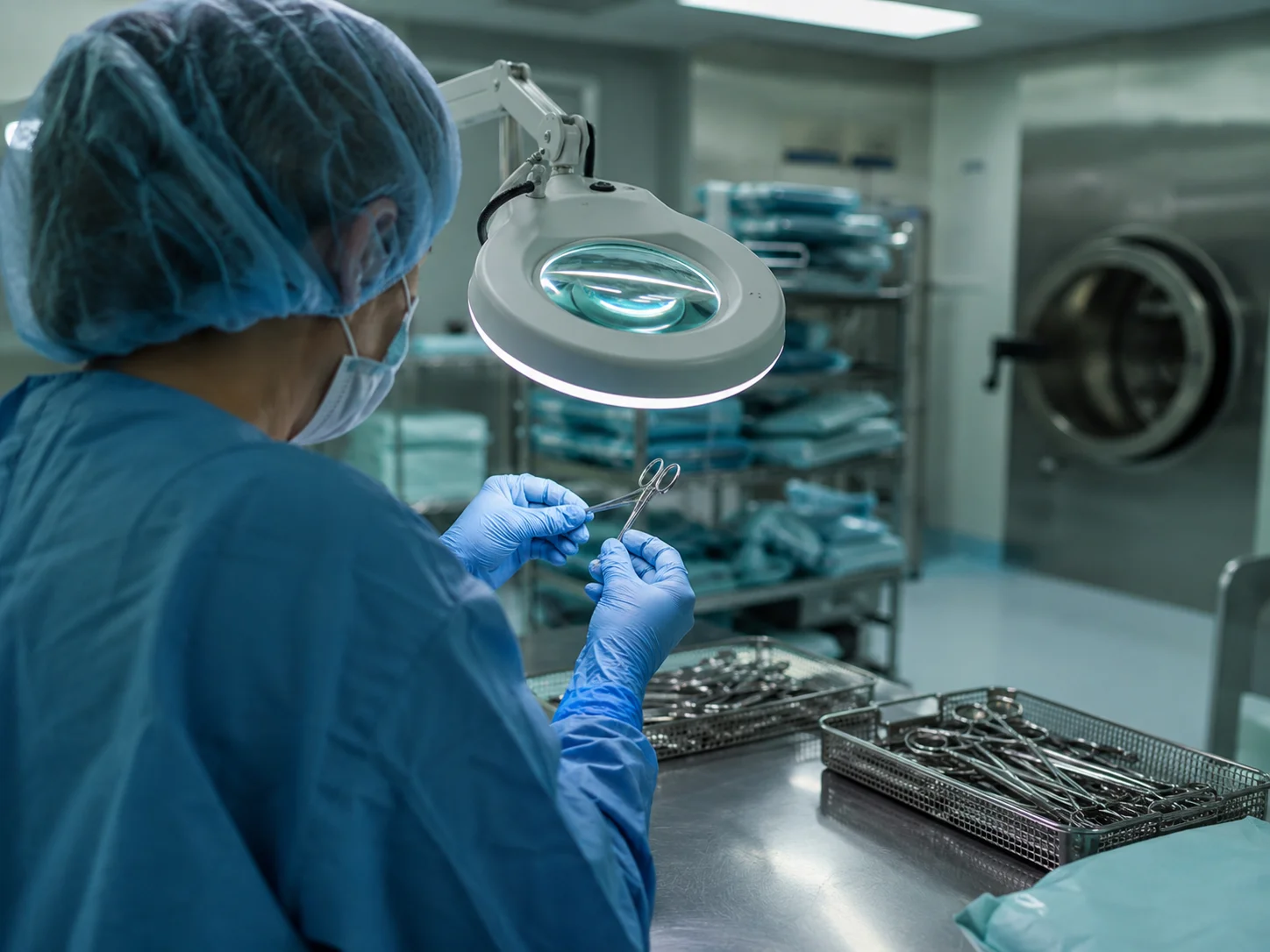
There is a room in every hospital that most patients never hear about and could not find with a map. It sits down the hall from the operating suites, it runs hot, and the people in it spend their shifts taking apart surgical instruments, washing them, inspecting them under magnification, wrapping them, running them through autoclaves, and tracking every tray by barcode so that when a surgeon opens a set at 6:40 in the morning, every clamp in it is sterile and accounted for. Get it wrong and somebody gets an infection. Get it right and nobody ever learns your name.
New York hospitals cannot hire enough of these people. They also cannot hire enough of the technologists who stand at the table during the operation, and the state has now said so in writing.
What the state is actually short of
The Center for Health Workforce Studies at the University at Albany published its 2026 assessment this summer, and the list of hospital shortage occupations is short and specific: clinical laboratory technologists, respiratory therapists, and surgical technicians. Not doctors. Not, in hospitals, primarily nurses. The technical roles that keep procedures running. Statewide healthcare employment grew 15 percent between 2020 and 2024, but the growth was lopsided, roughly 20 percent in New York City and on Long Island against about 3 percent everywhere else. Home healthcare added 41 percent. Nursing homes lost 4 percent.
Robert Martiniano, a senior program manager at the center, put the fix plainly in the report announcement: strengthening the workforce requires "producing more healthcare workers and retaining those already in the workforce." The first half of that sentence is where you come in, and there are now three separate doors into it, priced very differently.
The cheapest door opens September 14 and costs $4,400
Capital Region BOCES runs a sterile processing technician program out of the Albany area that takes seven months, September through March, and meets in the evening. Classroom sessions run 4:30 to 7:30 p.m. Clinical hours run 4 to 7 p.m. at Albany Medical Center. The total is roughly $4,400, and the school publishes the itemization instead of hiding it: $3,940 tuition, a $35 application fee, a $100 commitment fee credited back toward tuition, $200 for uniforms and supplies, and $125 for the certification exam paid directly to the vendor.
To get in you need a high school transcript or an equivalency diploma, a physical, and your immunizations. That is the entire academic gate. The Capital Region BOCES program reports 100 percent job placement across its first three years of operation and cites a mean New York salary of $51,290 for the role, a figure that comes from the school rather than from federal wage tables, so treat it as the school's number and ask them how they got it.
The next cohort starts September 14, 2026. That is under four weeks out.
Fifty-one thousand dollars is not a fortune in New York. It is also a starting wage for a job you can be trained into in seven months of evening classes for the price of a used car, in a department that runs 24 hours and pays shift differentials, inside an institution that will pay for your next credential once you are on the payroll. That last part matters more than the starting number, and we will come back to it.
The two-year version, and what it pays
Sterile processing is the loading dock. Surgical technology is the table. A surgical technologist scrubs in, sets up the sterile field, passes instruments to the surgeon, counts sponges, and manages the equipment during the procedure. The federal Bureau of Labor Statistics puts the median at $62,830 a year as of 2024, lists the typical entry-level education as a postsecondary nondegree award, and lists required prior work experience as none and required on-the-job training as none. That combination is rare. Most jobs paying above the national median want either a degree or years you do not have yet.
The surgical technologist salary figure is national. New York runs above the national mean for most allied health roles, but we could not pull a verified state-level number for this occupation, so we are not printing one. Ask any program you are considering for its own graduate placement wages and make them show you the range, not the ceiling.
What the credential actually requires
The certification that employers ask for is the CST, awarded by the National Board of Surgical Technology and Surgical Assisting. The CST certification requirements have one hard gate: you must graduate from a program accredited by CAAHEP or ABHES, or come through a recognized military pathway. You cannot study on your own and sit the exam. This is worth knowing before you pay anybody, because unaccredited "surgical tech" training exists and it is a dead end that costs the same as the real thing.
Nassau Community College on Long Island runs a CAAHEP-accredited associate program and publishes outcomes that most schools would rather not: 85 percent completion over five years, 96 percent job placement over five years, and a 95 percent first-time CST pass rate for the class of 2023. Those are the numbers to ask every program for. If a school will not give them to you, that is your answer.
The version where somebody else pays
Upstate, United Health Services in Binghamton runs an Education Incentive Program that covers tuition, fees, textbooks and the certification exam for an associate degree in surgical technology through Mohawk Valley Community College. You need a high school diploma or equivalent. You are hired first, paid as an operating room technician trainee while you study, and you commit to three years at 36 or more hours a week after you finish.
Three years is a real obligation and you should read the agreement like it is a mortgage, because functionally it is one. But employer paid tuition healthcare arrangements are how a lot of people in this state have gotten a credential without a loan, and hospitals are offering them now precisely because the shortage report above is accurate. Leverage is temporary. It exists while the vacancy list is long.
Washington finally started paying for short programs
We covered Workforce Pell when it was still a promise. It is now a list. The U.S. Department of Education approved the nation's first program in early August, an EMT course at Iowa Central Community College that runs 14 weeks. North Carolina followed on August 13 by clearing 43 short-term programs across 16 community colleges for eligibility, pending federal sign-off within 120 days.
Look at what made the cut. Nurse aide. EMT. Electrical lineworker. Welding. Truck driving. Healthcare and public safety dominated the first state list in the country, which tells you what the Workforce Pell Grant programs framework was built to fund and what it was not. Iowa Governor Kim Reynolds described the point as being able to "fast-track students within 8 to 15 weeks into rewarding careers with little-to-no debt." New York has been building the same kind of pipeline for years, from state-funded EV technician training to the rural diploma pathways our sister publication has tracked in upstate districts, but its own approved Workforce Pell list has not landed publicly yet. When it does, sterile processing is exactly the shape of program it was designed for, and you should be watching for it.
Why this lane and not the last one
We have written twice about sonography as a two-year credential that pays like a finance job, and it does. It is also becoming crowded, because everyone read the same article. Surgical technology and sterile processing sit one layer below in visibility and roughly one layer below in pay, which is precisely why the vacancies are open. No degree healthcare jobs New York employers are struggling to fill are rarely the glamorous ones. They are the ones nobody made a TikTok about.
There is also a durability argument. Instrument counts, sterile field management and intraoperative judgment are physical, high-liability, and performed in a room where a machine cannot currently be trusted alone. Robotic surgery expanded the technologist's job rather than eliminating it, because somebody still has to drape the robot, prep the trays, and be the second set of eyes on the count.
What to do in the next three weeks
Call Capital Region BOCES about the September 14 start and ask whether seats remain. If you are downstate, ask Nassau Community College for its next application cycle and its published outcomes. If you would rather not pay at all, call the human resources department of the nearest hospital system and ask, in these words, whether they run an education incentive or earn-while-you-learn program for operating room roles. Hospitals do not advertise these well. They fill them through people who ask.
Then check the New York State Department of Labor apprenticeship announcement page, which lists open application windows by trade and region and now carries dozens of them. The registered apprenticeship New York model has been escaping the building trades for two years, into public safety, healthcare support and technology, and the intake windows open and close on schedules nobody publicizes.
An allied health career pathway that starts in a decontamination room in March and ends at a surgical table three years later is not a fantasy. It is the ordinary route, and in this state right now it is unusually wide open. The programs start in September. The shortage report is already written.